Mera Peak vs Island Peak: Which Climb Is Right for You?
If you have completed a few Himalayan treks and are ready to take the next step into peak climbing in Nepal, two names are likely to appear again and again: Mera Peak and Island Peak.
Both are popular 6,000-meter-class climbing objectives. Both offer spectacular Himalayan scenery. Both require physical preparation, acclimatization and basic mountaineering skills. And both can be excellent choices for climbers looking for their first Himalayan peak.
But they are not the same experience.
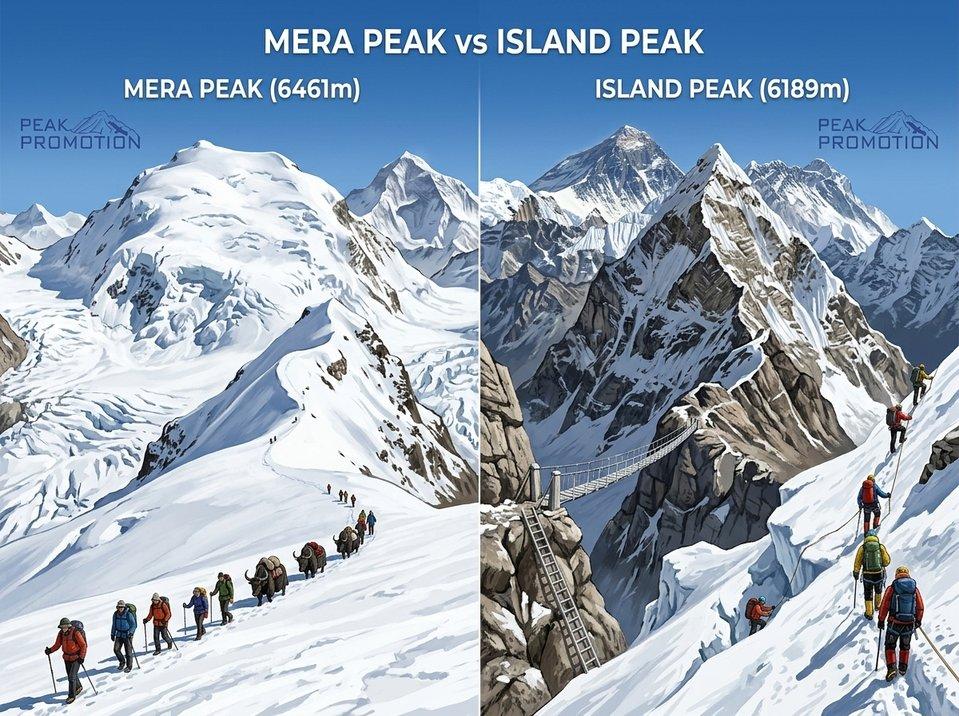
Mera Peak stands at 6,476 meters, making it higher than Island Peak. It is generally regarded as a less technical climbing objective, although the altitude itself makes it a serious undertaking.
Island Peak, also known as Imja Tse, rises to 6,189 meters and is generally considered more technical, with glacier travel, steep sections and fixed-rope climbing depending on route and conditions.
Peak Promotion currently classifies Mera Peak as a Moderate Trekking Peak with a 16-day itinerary, while Island Peak is listed as Moderate-Hard with an 18-day itinerary.
So which one should you choose?
The answer depends less on which mountain is "easier" and more on what kind of climbing experience you want.
Mera Peak vs Island Peak at a Glance
| Feature | Mera Peak | Island Peak |
| Height | 6,476 m | 6,189 m |
| Also Known As | Mera Peak | Imja Tse |
| Region | Everest/Makalu region | Everest/Khumbu region |
| General Difficulty | Moderate | Moderate-Hard |
| Technical Difficulty | Generally less technical | More technical |
| Main Challenge | Altitude and endurance | Technical climbing + altitude |
| Typical Peak-Climbing Experience | High-altitude climbing with basic mountaineering | Technical Himalayan climbing |
| Approach | Hinku Valley | Khumbu Valley |
| Scenery | Everest, Lhotse, Makalu, Kanchenjunga and more | Everest, Lhotse, Nuptse, Ama Dablam and surrounding peaks |
| Typical Peak Promotion Itinerary | 16 days | 18 days |
| Best For | Climbers prioritizing altitude and wilderness | Climbers seeking more technical climbing |
| Can Be a First Himalayan Peak? | Yes, with preparation and support | Yes, for appropriately prepared climbers |
| Key Skills | Crampon, ice axe, glacier and rope techniques as required | Glacier travel, crampon, rope and fixed-line techniques as required |
The classifications above are route- and condition-dependent; neither peak should be considered an "easy" mountain simply because it is categorized as a trekking peak. Peak Promotion describes Mera as a non-technical climbing peak while noting the need for basic mountaineering skills, and describes Island Peak as an introduction to more technical climbing.
What Is Mera Peak?
Mera Peak is 6,476 meters high and is located in the Everest/Makalu region of Nepal.
It is widely known as Nepal's highest trekking peak and offers climbers an opportunity to experience a summit above 6,000 meters without the advanced technical demands associated with many larger Himalayan mountains.
The journey takes climbers through the more remote Hinku Valley, with a route featuring forests, alpine landscapes, Sherpa settlements and high mountain terrain.
One of the major attractions of Mera Peak is its summit panorama.
From the summit area, climbers can see several of the world's highest mountains, including:
- Mount Everest
- Lhotse
- Makalu
- Cho Oyu
- Kanchenjunga
- Baruntse
The combination of wilderness, altitude and expansive mountain views makes Mera Peak particularly attractive to trekkers who want to transition into Himalayan mountaineering.
What Is Island Peak?
Island Peak, also known as Imja Tse, stands at 6,189 meters in Nepal's Everest region.
It is one of the most popular trekking peaks in the Khumbu and is particularly attractive to climbers who want an introduction to technical Himalayan climbing.
Unlike a conventional trek, an Island Peak expedition can involve:
- Glacier travel
- Crampon use
- Climbing harnesses
- Fixed ropes
- Ascenders
- Steeper snow and ice sections
- Rope-management techniques
The exact conditions and technical requirements can vary with the route, season and mountain conditions.
Island Peak is also well suited to climbers who want to combine peak climbing with an Everest-region trekking experience. Peak Promotion, for example, offers an itinerary combining Everest Base Camp and Island Peak, allowing climbers to experience both the classic trek and a summit attempt.
The Biggest Difference: Altitude vs Technical Difficulty
This is perhaps the most important distinction between Mera Peak and Island Peak.
At first glance, Mera Peak might appear more difficult because it is 287 meters higher.
But mountain difficulty is not determined by altitude alone.
A peak can be lower but technically more demanding.
✦ Mera Peak:
Mera's primary challenges include:
- High altitude
- Long summit day
- Physical endurance
- Acclimatization
- Cold
- Snow and glacier conditions
Peak Promotion describes Mera as a non-technical climbing peak while still emphasizing good fitness, acclimatization and basic mountaineering skills.
✦ Island Peak:
Island Peak generally places more emphasis on:
- Glacier travel
- Steeper climbing
- Fixed ropes
- Crampon technique
- Harness and rope systems
- Technical climbing confidence
Peak Promotion categorizes Island Peak as Moderate-Hard, compared with Mera Peak's Moderate Trekking Peak classification.
The Simple Difference
Mera Peak: higher altitude, generally less technical.
Island Peak: lower altitude, generally more technical.
That distinction can help you decide which mountain better matches your goals.
Mera Peak vs Island Peak: Which Is Harder?
There is no single answer.
It depends on what you personally find challenging.
If you are comfortable with trekking long distances and managing altitude but have limited technical climbing experience, Mera Peak may be the more natural progression.
If you want to learn and practice technical climbing techniques, Island Peak may offer the more suitable challenge, provided you prepare appropriately.
Neither should be treated as a simple hike.
Both require:
- Physical conditioning
- Altitude acclimatization
- Appropriate equipment
- Experienced climbing support
- Weather awareness
- Mountain safety planning
Peak Promotion's own beginner peak-climbing guidance emphasizes that choosing a first peak should take into account fitness, previous trekking experience, technical climbing experience, altitude experience, available time and climbing objectives.
Which Peak Is Higher?
Mera Peak is higher.
| Mountain | Elevation |
| Mera Peak | 6,476 m |
| Island Peak | 6,189 m |
| Difference | 287 m |
That difference may look relatively small on paper, but at high altitude every additional meter matters.
However, elevation alone should not determine your choice.
A climber who is comfortable with technical climbing may prefer Island Peak, while someone who wants to experience a higher summit with less technical terrain may prefer Mera Peak.
Which Has Better Mountain Views?
Both offer exceptional Himalayan scenery, but the character of the views is different.
✦ Mera Peak Views
Mera is especially attractive if your priority is a wide Himalayan panorama.
The summit provides views toward major peaks including:
- Everest
- Lhotse
- Makalu
- Cho Oyu
- Kanchenjunga
- Baruntse
Peak Promotion specifically highlights the summit panorama as one of the major rewards of the Mera Peak climb.
✦ Island Peak Views
Island Peak gives climbers a dramatic perspective of the Khumbu.
Depending on the location and conditions, views include:
- Ama Dablam
- Lhotse
- Nuptse
- Everest
- Baruntse
- Surrounding Khumbu peaks
The visual experience is particularly attractive for climbers who want to combine their summit attempt with the classic Everest region.
Which Has Better Views?
For a broad high-Himalayan panorama: Mera Peak has a strong advantage.
For an immersive Khumbu and Everest-region experience: Island Peak is an excellent choice.
Mera Peak Route and Experience
The Mera Peak journey generally begins with travel toward the Everest/Makalu region before entering the Hinku Valley.
The route provides a different atmosphere from the busy Everest Base Camp trail.
You can expect:
➜ Kathmandu preparation
➜ Travel toward the trekking starting point
➜ Trek through Hinku Valley
➜ Gradual altitude gain
➜ Acclimatization
➜ Arrival at Khare
➜ Climbing preparation
➜ Mera La/high-altitude progression
➜ High Camp
➜ Summit attempt
➜ Descent and return journey
Peak Promotion's current Mera Peak itinerary is listed at 16 days, with recommended climbing seasons of March–May and September–November.
One of Mera's attractions is that the climbing experience is integrated into a remote Himalayan trekking journey rather than being simply a summit-focused technical expedition.
Island Peak Route and Experience
Island Peak follows a different character of approach.
The mountain lies in the Khumbu, and the journey can be combined with the Everest Base Camp route.
A typical itinerary can include:
➜ Kathmandu preparation
➜ Flight toward Lukla
➜ Trek through the Khumbu
➜ Namche acclimatization
➜ Higher-altitude trekking
➜ Dingboche acclimatization
➜ Everest Base Camp/Kala Patthar depending on itinerary
➜ Trek toward Island Peak Base Camp
➜ Climbing training
➜ Summit attempt
➜ Descent
➜ Return through the Khumbu
Peak Promotion's current EBC-with-Island-Peak itinerary is listed at 20 days, while its standalone Island Peak climbing program is listed at 18 days.
This makes Island Peak particularly attractive if your dream is to combine Everest Base Camp trekking with a 6,000-meter summit.
Which Peak Is Better for Beginners?
Both can be considered by first-time peak climbers, but "beginner" should not mean "unprepared."
A person who has never climbed a Himalayan peak may still consider Mera or Island Peak if they have:
- Strong trekking fitness
- Good preparation
- Appropriate altitude acclimatization
- Basic mountaineering training
- Suitable equipment
- Professional climbing support
Peak Promotion identifies Mera Peak, Island Peak and Lobuche East as popular options for climbers considering their first Himalayan peak.
Mera Peak May Suit You If:
- You have limited technical climbing experience
- You want a higher summit
- You enjoy long trekking approaches
- You prefer a wilderness experience
- You want broad Himalayan views
- Your primary challenge is endurance and altitude
Island Peak May Suit You If:
- You want to learn technical climbing
- You are interested in glacier travel
- You want to practice fixed-rope techniques
- You want an Everest-region experience
- You want to combine the climb with EBC
- You are comfortable with steeper terrain
Mera Peak vs Island Peak: Technical Skills
Both mountains require appropriate mountaineering skills, but the emphasis differs.
Skills You May Need for Mera Peak:
Depending on conditions and route:
- Crampon use
- Ice axe use
- Glacier travel
- Rope techniques
- Harness use
- Basic snow movement
- High-altitude movement
Skills You May Need for Island Peak:
Depending on conditions:
- Crampon technique
- Glacier travel
- Fixed-rope movement
- Ascender use
- Descender use
- Harness management
- Ice and snow climbing
- Rope safety
Peak Promotion notes that climbing peaks may require equipment such as crampons, helmets, harnesses, ice axes, carabiners, ropes and ascenders/descenders.
You should receive appropriate instruction and practice before attempting technical sections.
Physical Preparation for Mera Peak and Island Peak
You do not need to be an elite athlete.
But you need to be prepared for prolonged physical effort at altitude.
Endurance
Build your cardiovascular endurance through:
- Hiking
- Running
- Cycling
- Stair climbing
- Incline walking
Strength
Focus on:
- Squats
- Lunges
- Step-ups
- Calf raises
- Core exercises
- Glute strengthening
Hiking Practice
Regular hiking is particularly valuable.
Gradually increase:
- Distance
- Elevation
- Walking duration
- Backpack weight
Technical Training
For Island Peak especially, technical training should be part of your preparation.
Practice should cover appropriate use of:
- Crampons
- Harness
- Ice axe
- Rope systems
- Ascender
- Descender
Your expedition team should provide or arrange mountain-specific training as appropriate.
Acclimatization: A Critical Part of Both Climbs
At more than 6,000 meters, altitude is one of the biggest challenges on both mountains.
Acclimatization is not something you can replace with fitness training.
Your itinerary needs to allow your body time to adjust as you ascend.
A good expedition itinerary may include:
- Rest days
- Gradual elevation gain
- Acclimatization hikes
- Controlled sleeping-altitude increases
- Extra time for weather or health issues
Do not judge an itinerary only by the number of days.
A shorter itinerary is not automatically a better itinerary.
For high-altitude climbing, appropriate acclimatization can be much more important than saving one or two days.
Best Time to Climb Mera Peak or Island Peak
The principal climbing seasons are generally spring and autumn.
Spring
March to May
Spring offers an important Himalayan climbing window, with increasingly favorable conditions toward the main expedition period.
Autumn
September to November
Autumn is another major trekking and mountaineering season, following the monsoon period.
Peak Promotion currently lists March–May and September–November as the best seasons for Mera Peak.
Weather can still vary significantly in the mountains, so the actual summit opportunity depends on conditions during the expedition.
Mera Peak vs Island Peak: Cost Considerations
There is no single fixed cost for either climb.
Your final budget depends on:
- Expedition duration
- Permits
- Guide and climbing staff
- Porter support
- Accommodation
- Food
- Domestic transportation
- Equipment
- Equipment rental
- Insurance
- Communication
- Rescue provisions
- Additional acclimatization days
- Weather delays
Island Peak can involve additional technical climbing logistics, while Mera Peak's longer high-altitude approach also contributes to expedition costs.
Rather than choosing solely based on the advertised package price, compare what is actually included.
Ask About:
- Climbing permit
- TIMS or applicable trekking documentation
- Accommodation
- Meals
- Domestic flights/transport
- Climbing guide
- Sherpa support
- Group equipment
- Personal equipment
- Insurance requirements
- Emergency arrangements
- Summit support
- Contingency days
Equipment: What Do You Need?
Both climbs require specialized equipment.
A typical equipment list can include:
Personal Equipment
- Mountaineering boots
- Crampons
- Down jacket
- Insulated trousers
- Waterproof shell
- Thermal layers
- Gloves
- Warm hat
- Sunglasses
- Goggles
- Sleeping bag
- Backpack
Climbing Equipment
- Mountaineering harness
- Helmet
- Ice axe
- Carabiners
- Ascender
- Descender
- Sling
- Climbing rope systems
The exact equipment depends on the expedition, route and current mountain conditions.
Do not purchase every item blindly. Your climbing operator should provide a route-specific equipment list and clarify which group equipment is supplied.
Mera Peak vs Island Peak: Which Has a Better Trek?
This depends on what kind of journey you want.
Choose Mera Peak for a More Remote Experience
Mera's Hinku Valley approach offers a quieter and more wilderness-oriented trekking environment.
You can experience:
- Forests
- Alpine valleys
- Remote settlements
- Sherpa culture
- High mountain landscapes
- Less crowded trekking trails
Peak Promotion specifically highlights the remote Hinku Valley and wilderness character of the Mera route.
Choose Island Peak for the Classic Khumbu Experience
Island Peak puts you in the heart of the Everest region.
You can potentially combine your climb with:
- Namche Bazaar
- Tengboche
- Dingboche
- Everest Base Camp
- Kala Patthar
- Chhukung Valley
- Sherpa cultural experiences
Peak Promotion's EBC-with-Island-Peak itinerary combines the first part of the journey with the Everest Base Camp trekking experience before moving toward Island Peak.
Mera Peak vs Island Peak: Which One Should You Choose?
Use this simple decision guide.
| If Your Priority Is... | Better Choice |
| Higher summit | Mera Peak |
| Less technical climbing | Mera Peak |
| Wilderness experience | Mera Peak |
| Broad Himalayan panorama | Mera Peak |
| Technical climbing practice | Island Peak |
| Glacier/fixed-rope experience | Island Peak |
| Everest-region experience | Island Peak |
| Combining with EBC | Island Peak |
| First high-altitude climbing experience | Either, depending on preparation |
| Preparing for more technical climbs | Island Peak |
| Strong trekking ability but limited technical experience | Mera Peak may be a better fit |
| Strong interest in mountaineering techniques | Island Peak may be a better fit |
Can You Climb Both Mera Peak and Island Peak?
Yes, some experienced and well-prepared climbers may choose to combine multiple objectives in Nepal.
However, this is not simply a matter of adding two summit days to one itinerary.
Combining peaks requires consideration of:
- Total duration
- Acclimatization
- Recovery
- Technical training
- Weather
- Route logistics
- Energy levels
- Permits
- Transportation
For a climber attempting their first 6,000-meter peak, completing one objective successfully may be a more sensible approach than trying to fit multiple summits into a tight schedule.
Mera Peak vs Island Peak for Future Mountaineering
Your first climbing peak can also be a learning experience for future objectives.
Mera Peak Can Help You Develop:
- High-altitude endurance
- Glacier experience
- Crampon confidence
- Ice-axe familiarity
- Summit-day discipline
- Acclimatization experience
Island Peak Can Help You Develop:
- Fixed-rope movement
- Ascender use
- Descender use
- Technical climbing confidence
- Glacier travel
- Steeper snow/ice movement
- Rope-system awareness
If your long-term ambition is to progress toward more technical Himalayan climbing, Island Peak can offer valuable technical exposure.
If your immediate goal is to experience a 6,000-meter summit while developing high-altitude trekking and mountaineering fundamentals, Mera Peak can be an attractive option.
Safety: Don't Confuse Trekking Peaks With Easy Mountains
The term "trekking peak" can sometimes make a mountain sound easier than it actually is.
Mera Peak and Island Peak are both high-altitude mountains.
Potential challenges include:
- Altitude illness
- Extreme cold
- Snow and ice
- High winds
- Poor visibility
- Fatigue
- Falls
- Changing weather
- Technical terrain
- Communication difficulties
Peak Promotion's mountaineering guidance emphasizes that trekking peaks still involve altitude, weather, terrain and technical considerations and should be approached with appropriate preparation and support.
A successful climb is not simply about reaching the summit.
Returning safely is part of the objective.
Why Professional Expedition Support Matters?
Peak climbing requires more than booking a hotel and following a trekking trail.
A professional expedition operator can assist with:
- Route planning
- Permits
- Transportation
- Accommodation
- Acclimatization itinerary
- Climbing guides
- Sherpa support
- Equipment logistics
- Base camp arrangements
- Communication
- Weather monitoring
- Emergency coordination
Peak Promotion currently operates dedicated 6,000-meter peak-climbing programs, including Mera Peak and Island Peak, alongside a broader portfolio of Himalayan expeditions.
The company states that it has operated in Nepal since 1992, with experience in trekking, mountaineering and expedition logistics.
For first-time peak climbers, professional support can make the difference between simply attempting a mountain and approaching it with a structured plan.
Why Choose Peak Promotion for Your Mera or Island Peak Climb?
Choosing the right mountain is only the first step.
Your expedition also depends on:
- Experienced mountain staff
- Appropriate acclimatization
- Reliable logistics
- Equipment planning
- Route knowledge
- Transportation coordination
- Emergency preparedness
Peak Promotion offers dedicated climbing programs for both Mera Peak and Island Peak, allowing climbers to choose an objective based on their experience, fitness, technical interests and available time.
Whether you want the higher, more wilderness-oriented experience of Mera Peak or the more technical climbing character of Island Peak, the expedition should be planned around your actual abilities—not simply the mountain's popularity.
Frequently Asked Questions (FAQ's):
Q. Is Mera Peak harder than Island Peak?
Not necessarily. Mera Peak is higher at 6,476 meters, but it is generally less technical. Island Peak is lower at 6,189 meters but involves more technical climbing terrain.
Q. Which is better for a first-time climber?
Both can be considered by appropriately prepared first-time peak climbers. Mera may suit climbers who want a higher but generally less technical objective, while Island Peak may suit those specifically interested in learning technical climbing.
Q. Which is higher, Mera Peak or Island Peak?
Mera Peak is higher. Mera Peak reaches 6,476 meters, while Island Peak reaches 6,189 meters.
Q. Is Mera Peak technical?
Mera Peak is generally considered less technical than Island Peak, but it still requires appropriate mountaineering skills, equipment, acclimatization and high-altitude preparation.
Q. Is Island Peak technical?
Yes. Island Peak is generally considered the more technical of the two and can involve glacier travel, steep sections and fixed-rope techniques depending on conditions.
Q. Can beginners climb Mera Peak?
Some climbers without previous summit experience undertake Mera Peak, but beginners need strong physical preparation, proper acclimatization, basic mountaineering training and professional support.
Q. Can beginners climb Island Peak?
First-time peak climbers can consider Island Peak, but its technical nature means they should be appropriately trained and prepared for glacier and rope-based climbing.
Q. Can Mera Peak be combined with trekking?
Yes. Mera Peak itself involves a trekking approach through the Hinku Valley before the climbing section.
Q. Can Island Peak be combined with Everest Base Camp?
Yes. Island Peak can be incorporated into an Everest Base Camp and Island Peak itinerary. Peak Promotion currently offers a combined program.
Q. Which peak has better views?
Both offer exceptional scenery. Mera Peak is particularly known for its broad panorama of major Himalayan peaks, while Island Peak offers an immersive Khumbu experience with views of mountains such as Ama Dablam, Lhotse and Nuptse.
Q. How long does Mera Peak climbing take?
Peak Promotion currently lists a 16-day Mera Peak climbing itinerary.
Q. How long does Island Peak climbing take?
Peak Promotion currently lists an 18-day Island Peak climbing itinerary, while a combined EBC and Island Peak program is listed at 20 days.
Q. What equipment do I need for Mera Peak and Island Peak?
Both require specialized mountaineering equipment, potentially including crampons, ice axe, harness, helmet, ropes and other climbing equipment. Your expedition operator should provide a current route-specific equipment list.
Q. Which peak should I choose if I want to become a mountaineer?
If you want more technical climbing exposure, Island Peak may be the more suitable choice. If you want to build high-altitude experience with a generally less technical climbing profile, Mera Peak may be a better starting point.
Final Verdict: Mera Peak or Island Peak?
There is no universal winner.
Choose Mera Peak if you want:
- A higher summit
- A generally less technical climbing experience
- A remote Hinku Valley journey
- A broad Himalayan panorama
- A strong introduction to high-altitude peak climbing
Choose Island Peak if you want:
- More technical climbing
- Glacier and fixed-rope experience
- A Khumbu/Everest-region adventure
- The possibility of combining the climb with Everest Base Camp
- More emphasis on developing mountaineering techniques
In simple terms:
Mera Peak is a great choice if altitude, endurance and wilderness appeal to you. Island Peak is a strong choice if technical climbing and the Everest region are your priorities.
Whichever mountain you choose, remember that a 6,000-meter peak is a serious high-altitude objective. Physical preparation, acclimatization, technical training, appropriate equipment, weather awareness and experienced mountain support are essential.
Ready to Choose Your Himalayan Peak?
Take the next step from trekking to mountaineering with professional local support.
Peak Promotion Pvt. Ltd.
Contact: +977 9841135705
Email: info@peakpromotionnepal.com
Location: Lazimpat, Kathmandu 44600, Nepal
Plan your Mera Peak or Island Peak climb with Peak Promotion Nepal.