Nepali Army’s Historic Ascent of Mt. Kanchenjunga: A Landmark Himalayan Expedition
Nepal's Himalayan landscape has produced generations of mountaineers who have challenged some of the highest and most technically demanding peaks on Earth.
Among these mountains, Mount Kanchenjunga, rising to 8,586 meters, holds a special place. It is the third-highest mountain in the world and one of the most demanding 8,000-meter peaks to climb.
The mountain's remote location, technical terrain, unpredictable weather, and extreme altitude make a successful summit a major mountaineering achievement.
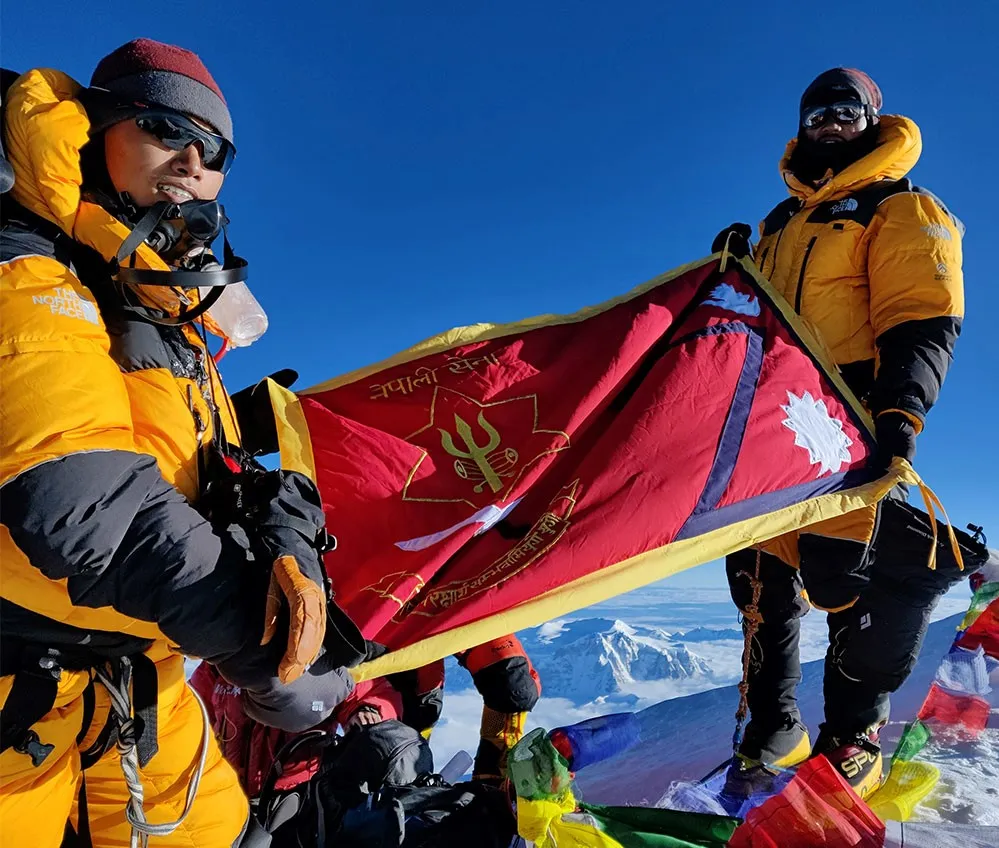
Against this challenging backdrop, two Nepali Army personnel—Captain Raju Shrestha and Jawan Amit Thapa—successfully reached the summit of Mt. Kanchenjunga, according to the expedition information provided by Peak Promotion.
Their ascent represented a milestone in Nepali Army mountaineering, with the expedition combining high-altitude climbing with an environmental clean-up initiative in the Kanchenjunga region.
The expedition was professionally organized and managed by Peak Promotion Pvt. Ltd., with an experienced Sherpa team providing high-altitude climbing and logistical support.
Mt. Kanchenjunga: The Third-Highest Mountain in the World
Mount Kanchenjunga stands at 8,586 meters above sea level, making it the third-highest mountain on Earth after Mount Everest and K2.
The mountain lies along the Nepal–India border, with the main massif located in the eastern Himalayas.
Kanchenjunga is renowned not only for its height but also for the difficulty involved in reaching its summit.
The mountain presents a combination of:
- Extreme altitude
- Technical climbing sections
- Remote approaches
- Severe weather
- Snow and ice
- Steep terrain
- High-altitude risks
These factors make a Kanchenjunga expedition considerably different from many conventional trekking experiences.
Why Kanchenjunga Is Considered a Challenging 8,000-Meter Peak?
Climbing above 8,000 meters is inherently demanding.
At such elevations, the human body operates in an environment where oxygen availability is significantly reduced compared with sea level.
Kanchenjunga adds additional challenges because of its remote location and difficult terrain.
➜ Extreme Elevation
At 8,586 meters, Kanchenjunga reaches deep into the Earth's high-altitude environment.
Climbers must deal with:
- Low oxygen availability
- Freezing temperatures
- Strong winds
- Physical exhaustion
- Exposure to altitude-related illness
Proper acclimatization and expedition planning are therefore essential.
➜ Remote Location
Kanchenjunga is located in eastern Nepal, far from the country's major urban centers.
Getting personnel, equipment, food, climbing gear, communications equipment, and other supplies into the region requires careful planning.
Unlike popular trekking routes with extensive tourism infrastructure, Kanchenjunga remains comparatively remote.
This makes expedition logistics an important part of the climb.
➜ Unpredictable Weather
Himalayan weather can change quickly.
Strong winds, snowfall, low visibility, and freezing conditions can affect climbing schedules and route safety.
Expedition teams therefore need to monitor conditions continuously and be prepared to adjust their plans.
The Historic Nepali Army Ascent
The successful ascent by Captain Raju Shrestha and Jawan Amit Thapa marked an important moment in Nepal's military mountaineering history.
According to the expedition information provided, they became the first Nepali Army personnel to summit Mt. Kanchenjunga.
Their achievement demonstrated the physical preparation, technical skills, teamwork, and determination required for an expedition on an 8,000-meter mountain.
The climb also connected two important aspects of Nepal's national identity:
military service and Himalayan mountaineering.
Nepal's armed forces have participated in various mountain-related activities, including environmental campaigns and high-altitude operations. The Kanchenjunga expedition added another chapter to that involvement.
Captain Raju Shrestha and Jawan Amit Thapa
The summit team consisted of:
Captain Raju Shrestha
Captain Raju Shrestha participated in the Kanchenjunga expedition as one of the Nepali Army climbers who reached the summit.
Jawan Amit Thapa
Jawan Amit Thapa joined Captain Shrestha in the historic summit attempt and successfully reached the top of the 8,586-meter mountain.
Their successful ascent required preparation well beyond ordinary physical fitness.
High-altitude climbing involves:
- Technical climbing ability
- Endurance
- Acclimatization
- Cold-weather preparation
- Team coordination
- Route awareness
- Risk management
The Role of Peak Promotion in the Kanchenjunga Expedition
A successful 8,000-meter expedition depends on far more than the climbers who reach the summit.
It requires a large operational structure supporting the expedition from preparation through the summit phase and return.
Peak Promotion Pvt. Ltd. professionally organized and managed the expedition, according to the information provided.
Its role involved coordinating the different logistical requirements associated with the climb.
These can include:
- Expedition planning
- Transportation
- Equipment logistics
- Accommodation
- Base camp arrangements
- High-altitude support
- Sherpa coordination
- Route logistics
- Communication
- Field operations
For remote Himalayan expeditions, these behind-the-scenes responsibilities can be as important as the summit climb itself.
Why Expedition Logistics Matter on an 8,000-Meter Mountain?
When an expedition takes place on a remote mountain, logistics become a complex process.
Equipment cannot simply be transported by road directly to the climbing area.
Instead, supplies may move through several stages:
Kathmandu → Regional Transport → Trekking Route → Base Camp → Higher Camps → Summit Operations
At each stage, teams must coordinate:
- People
- Equipment
- Food
- Fuel
- Climbing gear
- Communication equipment
- Medical supplies
- Waste management
A disruption at one stage can affect the entire expedition.
This is why experienced expedition management is particularly important for remote Himalayan climbs.
The Sherpa Team Supporting the Expedition
The Nepali Army climbers were supported by an experienced Sherpa team.
The expedition team included:
- Chhiring Jangbu Sherpa
- Furba Sherpa
- Ngima Chhiring Sherpa
- Chhewang Sherpa
According to the supplied expedition information, Chhiring Jangbu Sherpa is an IFMGA-certified mountain guide.
The knowledge and experience of high-altitude mountain professionals are critical during 8,000-meter expeditions.
Sherpa teams can contribute expertise in:
- Route finding
- High-altitude climbing
- Load management
- Camp establishment
- Rope work
- Mountain safety
- Weather awareness
- Expedition logistics
Their role extends throughout the expedition rather than being limited to the summit push.
What Does an IFMGA Mountain Guide Do?
The International Federation of Mountain Guides Associations (IFMGA) represents professional mountain guiding organizations internationally.
An IFMGA-qualified guide has professional training relevant to mountain guiding.
On complex expeditions, professional mountain guides can contribute to:
- Technical climbing
- Route selection
- Risk assessment
- Client and team management
- Mountain navigation
- Safety procedures
- Emergency decision-making
For demanding peaks such as Kanchenjunga, experienced technical leadership is an important component of expedition planning.
The Environmental Dimension of the Expedition
The Kanchenjunga expedition was not solely focused on reaching the summit.
According to the supplied information, the expedition also incorporated an environmental cleaning campaign in the Kanchenjunga region.
This adds an important conservation dimension to the expedition.
Himalayan mountaineering creates an environmental responsibility because high-altitude areas can be extremely difficult to clean and maintain.
Waste management can involve:
- Collection
- Sorting
- Temporary storage
- Transportation
- Disposal
- Removal of abandoned materials
Combining mountaineering activities with environmental conservation can help reinforce the importance of responsible expedition practices.
Why Mountain Conservation Matters in Kanchenjunga
Kanchenjunga is part of an environmentally significant Himalayan region.
The area includes high-altitude ecosystems, glaciers, alpine landscapes, forests, and wildlife habitats.
The mountain environment is also important to local communities and tourism.
Maintaining the area's environmental quality therefore requires attention to:
• Waste Management
Expedition teams need to minimize the amount of waste left behind at camps and along climbing routes.
• Responsible Tourism
Visitors and expedition operators should respect local environmental and cultural conditions.
• Conservation
Mountain landscapes need long-term protection from unmanaged tourism and expedition activity.
• Community Participation
Local communities and mountain workers are essential partners in sustainable tourism and conservation.
The Importance of Teamwork in High-Altitude Mountaineering
A summit photograph may show only a few climbers, but a major Himalayan expedition involves many people.
A successful expedition can require cooperation between:
Climbers + Mountain Guides + Sherpa Teams + Logistics Staff + Expedition Managers + Support Personnel
Every group performs a different function.
The climbers focus on the physical and technical challenge of reaching the summit.
Mountain guides provide technical and safety expertise.
Sherpa teams contribute local mountain knowledge and high-altitude experience.
Logistics teams make sure equipment, supplies, transportation, and operational resources are available.
Expedition managers coordinate these components.
Preparing for an 8,000-Meter Expedition
Preparation for a mountain such as Kanchenjunga begins long before the team reaches the Himalayas.
✔ Physical Preparation
Climbers need significant endurance and strength.
Training may include:
- Cardiovascular conditioning
- Strength training
- Endurance exercises
- Hiking
- Load carrying
- Technical climbing practice
✔ Acclimatization
Acclimatization is essential when ascending to extreme elevations.
Teams generally use planned elevation gains and rest periods to allow the body to adapt to reduced oxygen availability.
The exact acclimatization strategy depends on the route, weather, expedition schedule, individual climbers, and other operational factors.
✔ Technical Preparation
An 8,000-meter mountain can require specialized climbing skills.
Depending on the route and conditions, climbers may need experience with:
- Fixed ropes
- Ice climbing
- Snow climbing
- Rock sections
- Crampon use
- Ascender systems
- Rappelling
- High-altitude equipment
Equipment Required for High-Altitude Expeditions
An expedition to an 8,000-meter peak requires specialized equipment.
Typical categories include:
| Equipment Category | Examples |
| Clothing | Down suits, thermal layers, gloves |
| Footwear | High-altitude mountaineering boots |
| Climbing equipment | Harness, helmet, carabiners |
| Snow/ice equipment | Crampons, ice axe |
| Rope systems | Fixed ropes, ascenders |
| Camping | High-altitude tents, sleeping bags |
| Safety | First-aid and emergency equipment |
| Navigation | GPS and communication equipment |
| Oxygen systems | Supplemental oxygen equipment where used |
| Logistics | Cooking, fuel and expedition supplies |
The exact equipment required varies according to the mountain, route, season, climbing style, and expedition plan.
Kanchenjunga and Nepal's Mountaineering Legacy
Nepal is internationally associated with Himalayan mountaineering.
The country is home to some of the world's highest mountains and has developed a substantial ecosystem around:
- Trekking
- Mountaineering
- Expedition management
- Mountain guiding
- Tourism
- High-altitude logistics
The Kanchenjunga ascent by Nepali Army personnel adds another milestone to this broader history.
It demonstrates how mountaineering continues to involve not only professional climbers but also organizations and institutions with specialized mountain capabilities.
What Makes a Kanchenjunga Expedition Different?
A Kanchenjunga expedition differs from a conventional Nepal trekking trip in several important ways.
| Trekking | 8,000m Expedition |
| Established trekking routes | Technical climbing routes |
| Lower elevations | Extreme altitude |
| Teahouses/lodges often available | Expedition camps required |
| Basic trekking equipment | Specialized climbing equipment |
| Shorter operational cycles | Extended expedition planning |
| More accessible infrastructure | Remote logistics |
| Trekking guide | Specialized mountain guides and climbing teams |
This distinction is important for travelers researching Himalayan adventures.
A trek to a mountain viewpoint and an expedition to an 8,000-meter summit require completely different levels of preparation.
The Significance of the Achievement
The reported first ascent of Kanchenjunga by Nepali Army personnel represents several dimensions of achievement.
• Military Mountaineering
It represents a significant milestone in the Nepali Army's involvement in high-altitude mountaineering.
• Himalayan Expertise
The expedition involved Nepali climbers, Sherpa professionals, and a Nepal-based expedition management company.
• Environmental Responsibility
The expedition also incorporated a mountain-cleaning component.
• Expedition Management
The successful operation demonstrated the importance of logistics, planning, technical support, and teamwork.
Peak Promotion and Nepal's Expedition Industry
Peak Promotion Pvt. Ltd.'s involvement in the Kanchenjunga expedition reflects the broader role of Nepal-based companies in supporting Himalayan mountaineering.
Professional expedition companies can connect international and domestic climbers with the operational infrastructure needed to undertake challenging mountain journeys.
Their work can extend beyond arranging a basic itinerary.
For technical expeditions, support may involve:
- Expedition planning
- Permits and documentation
- Transportation
- Accommodation
- Sherpa teams
- Equipment
- Base camps
- High-altitude logistics
- Communication
- Environmental considerations
This operational ecosystem is an important part of Nepal's mountain tourism industry.
A New Chapter in Nepali Army Mountaineering
The successful Kanchenjunga ascent by Captain Raju Shrestha and Jawan Amit Thapa represents a notable chapter in Nepal's military mountaineering story.
Their expedition brought together military personnel, professional mountain guides, Sherpa climbers, expedition managers, and environmental objectives.
It also demonstrated the demanding nature of climbing an 8,000-meter Himalayan peak.
For Nepal's mountaineering community, such expeditions contribute to the country's continuing association with high-altitude climbing and Himalayan adventure.
Frequently Asked Questions (FAQ's):
Q. How high is Mount Kanchenjunga?
Mount Kanchenjunga is 8,586 meters (28,169 feet) high, making it the third-highest mountain in the world.
Q. Where is Mount Kanchenjunga located?
Kanchenjunga is located along the Nepal–India border in the eastern Himalayas.
Q. Is Kanchenjunga difficult to climb?
Kanchenjunga is considered a highly demanding 8,000-meter mountain because of its extreme altitude, technical terrain, remote location, and unpredictable Himalayan weather.
Q. Who were the Nepali Army personnel who climbed Kanchenjunga?
According to the supplied expedition information, Captain Raju Shrestha and Jawan Amit Thapa successfully reached the summit.
Q. Were they the first Nepali Army personnel to summit Kanchenjunga?
According to the expedition information provided by Peak Promotion, Captain Raju Shrestha and Jawan Amit Thapa became the first Nepali Army personnel to reach the summit of Mt. Kanchenjunga.
Q. Who organized the Kanchenjunga expedition?
The expedition was professionally organized and managed by Peak Promotion Pvt. Ltd., according to the supplied information.
Q. Who supported the Nepali Army climbers?
The expedition was supported by Sherpa climbers including Chhiring Jangbu Sherpa, Furba Sherpa, Ngima Chhiring Sherpa, and Chhewang Sherpa.
Q. Who is Chhiring Jangbu Sherpa?
According to the supplied expedition information, Chhiring Jangbu Sherpa is an IFMGA-certified mountain guide who supported the Kanchenjunga expedition.
Q. Why is Kanchenjunga important to Nepal?
Kanchenjunga is one of Nepal's major Himalayan peaks and an important part of the country's mountaineering, tourism, environmental, and cultural landscape.
Q. What environmental work was associated with the expedition?
The expedition combined the summit attempt with an environmental cleaning campaign in the Kanchenjunga region.
Q. What equipment is needed to climb an 8,000-meter mountain?
Depending on the route and conditions, climbers may require specialized clothing, mountaineering boots, crampons, ice axes, harnesses, ropes, ascenders, high-altitude tents, communication equipment, and other expedition gear.
Q. Why are Sherpa climbers important in Himalayan expeditions?
Sherpa climbers contribute extensive knowledge of Himalayan terrain, high-altitude operations, route management, technical climbing, logistics, and mountain safety.
Conclusion
The reported summit of Mt. Kanchenjunga by Captain Raju Shrestha and Jawan Amit Thapa represents a significant event in the history of Nepali Army mountaineering.
At 8,586 meters, Kanchenjunga presents a combination of extreme altitude, technical climbing, remote terrain, and unpredictable weather. Successfully operating in such an environment requires careful preparation and coordination.
The expedition brought together Nepali Army personnel, experienced Sherpa climbers, professional mountain guides, and expedition logistics specialists.
Peak Promotion Pvt. Ltd.'s role in organizing and managing the expedition demonstrates the importance of professional logistics in high-altitude mountaineering. The inclusion of an environmental cleaning campaign also connected the expedition with the broader responsibility of protecting Nepal's Himalayan environment.
The achievement of Captain Raju Shrestha and Jawan Amit Thapa adds another chapter to Nepal's long association with Himalayan mountaineering.
More importantly, it highlights a principle that applies to every major Himalayan expedition: summiting a mountain is a team effort that depends on preparation, expertise, logistics, safety, and respect for the mountain environment.
For Nepal, where the Himalayas form an important part of both national identity and the tourism economy, continuing to combine mountaineering excellence with environmental responsibility will remain an important part of the country's mountain future.