10 Easy Treks in Nepal for Beginners
Nepal is famous for Mount Everest, Annapurna, Langtang and some of the world's most challenging high-altitude trekking routes. But you do not need to be an experienced mountaineer to enjoy the Himalayas.
There are many easy treks in Nepal for beginners that combine mountain scenery, traditional villages, forests, local culture and comfortable teahouse accommodation without requiring technical climbing skills.
For a first trek, however, "easy" should be understood in context. A route can be beginner-friendly while still involving several hours of walking, uphill sections and changing weather. Altitude is also important. A shorter trek at 3,000 meters can feel very different from a low-altitude hike near Pokhara.
The best beginner trek therefore depends on your:
- Fitness level
- Previous hiking experience
- Available time
- Maximum comfortable altitude
- Budget
- Preferred scenery
- Interest in culture
- Travel season
- Desired level of comfort
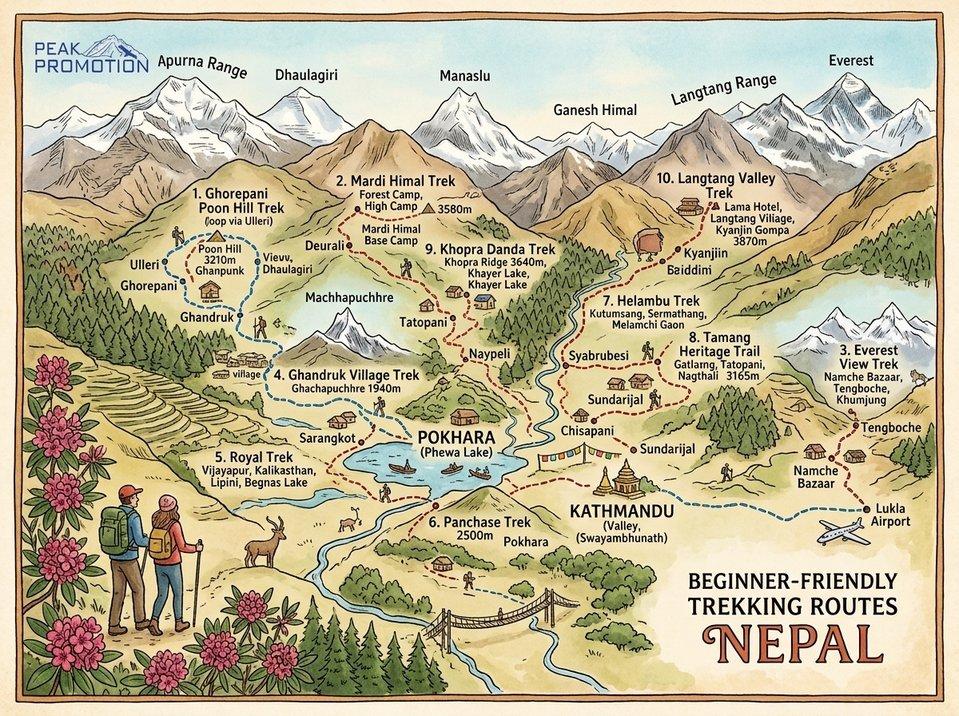
This guide covers 10 beginner-friendly treks in Nepal, from short hill walks around Pokhara to Himalayan routes that introduce first-time trekkers to higher elevations.
10 Easy Treks in Nepal for Beginners at a Glance
| # | Trek | Approx. Duration | Approx. Highest Point | General Difficulty | Best For |
| 1 | Ghorepani Poon Hill Trek | 5–7 days | 3,210 m | Easy–Moderate | First Himalayan trek |
| 2 | Mardi Himal Trek | 5–7+ days | ~4,500 m | Easy–Moderate | Mountain views |
| 3 | Everest View Trek | 7–10 days | ~3,880 m | Moderate | First Everest-region experience |
| 4 | Ghandruk Trek | 2–4 days | ~2,000–2,500 m | Easy | Village & culture |
| 5 | Royal Trek | 3–5 days | ~1,700–2,000 m | Easy | Families & beginners |
| 6 | Panchase Trek | 2–4 days | 2,513 m | Easy | Short Pokhara trek |
| 7 | Helambu Trek | 5–7 days | ~3,600 m | Easy–Moderate | Culture & mountain scenery |
| 8 | Tamang Heritage Trail | 5–7+ days | ~3,165 m | Moderate | Culture & villages |
| 9 | Khopra Danda Trek | 7–11 days | ~4,660 m | Moderate | Quiet Himalayan trails |
| 10 | Langtang Valley Trek | 7–10 days | ~3,800 m | Moderate | First longer Himalayan trek |
Important: Duration and maximum altitude can vary according to the itinerary. The routes above are not ranked from "easiest" to "hardest." They represent different options for first-time trekkers.
1. Ghorepani Poon Hill Trek
Best for: First-time Himalayan trekkers
The Ghorepani Poon Hill Trek is one of the most popular short trekking routes in Nepal and one of the most practical choices for beginners.
The trek takes you through rhododendron forests, traditional villages and mountain landscapes before reaching Poon Hill at 3,210 meters.
The viewpoint is particularly famous for sunrise views over the Annapurna and Dhaulagiri ranges.
Peak Promotion currently lists its Ghorepani Poon Hill Trek as a 7-day Easy–Moderate trek, with a maximum altitude of 3,210 meters.
Highlights:
- Poon Hill sunrise
- Annapurna mountain views
- Dhaulagiri views
- Rhododendron forests
- Gurung and Magar villages
- Ghorepani
- Tadapani
- Ghandruk
- Teahouse accommodation
Why beginners like it?
The route provides a genuine Himalayan trekking experience without requiring the very high altitudes associated with Everest Base Camp or high mountain passes.
It is also relatively easy to combine with a visit to Pokhara.
Typical duration:
5–7 days
Maximum altitude:
3,210 m
Difficulty:
Easy–Moderate
Best seasons:
March–May and September–November
2. Mardi Himal Trek
Best for: Beginners who want closer mountain views:
The Mardi Himal Trek is located in the Annapurna region and is known for spectacular views of Machhapuchhre, Annapurna South, Hiunchuli and Mardi Himal.
The trail passes through forests, traditional villages and increasingly alpine landscapes.
Peak Promotion currently lists Mardi Himal as an 11-day itinerary, with a maximum altitude of approximately 4,500 meters and a classification of Easy on its current trek page.
However, the higher sections can still be physically demanding, so first-time trekkers should prepare properly.
Highlights:
- Machhapuchhre/Fishtail
- Annapurna South
- Mardi Himal
- Rhododendron forests
- Gurung communities
- Peaceful trails
- High Camp
- Mardi Himal Base Camp viewpoint
Why beginners like it?
Mardi Himal combines relatively short trekking days with impressive mountain scenery.
It is particularly attractive if you want something more Himalayan than a low-altitude village trek.
Typical duration:
5–8+ days, depending on itinerary
Maximum altitude:
Approximately 4,500 m
Difficulty:
Easy–Moderate for a prepared trekker
Best seasons:
March–May and September–November
3. Everest View Trek
Best for: Beginners who want to experience the Everest region
You do not necessarily have to trek all the way to Everest Base Camp to experience the Khumbu region.
The Everest View Trek provides a shorter introduction to the Everest region, including Namche Bazaar, Sherpa villages and views of Everest and surrounding peaks.
The Nepal Tourism Board's current TIMS information specifically lists Everest View Trek among the routes requiring a licensed guide and agency-issued TIMS under the current provisions.
Highlights:
- Mount Everest views
- Namche Bazaar
- Sherpa culture
- Khumbu landscapes
- Buddhist monasteries
- Ama Dablam
- Thamserku
- Himalayan villages
Why beginners like it?
It provides a taste of the Everest region without requiring the full duration and altitude profile of the Everest Base Camp Trek.
However, the trek still involves significant elevation gain and should not be treated like a low-altitude hike.
Typical duration:
7–10 days
Difficulty:
Moderate
Best seasons:
March–May and October–November
4. Ghandruk Trek
Best for: Beginners interested in culture and village life
If your priority is traditional Himalayan culture rather than extreme altitude, a Ghandruk Trek can be an excellent introduction to trekking in Nepal.
Ghandruk is a traditional Gurung village in the Annapurna region, with mountain views and cultural attractions.
Nepal Tourism Board highlights Ghandruk's Gurung museum, traditional village environment and views of Annapurna South, Gangapurna, Annapurna III, Hiunchuli and Machhapuchhre.
The route can also be incorporated into longer Annapurna itineraries.
Highlights:
- Traditional Gurung village
- Gurung Museum
- Annapurna views
- Machhapuchhre views
- Rhododendron forests
- Local food
- Mountain village experience
Why beginners like it?
Ghandruk can be reached relatively easily from Pokhara, and Nepal Tourism Board notes that the village is approximately a 4–5-hour drive from Pokhara.
This makes it useful for travelers who want a short Himalayan escape without committing to a week-long high-altitude trek.
Typical duration:
2–4 days
Difficulty:
Easy
Best seasons:
March–May and September–November
5. Royal Trek
Best for: Families and first-time trekkers
The Royal Trek is one of the shorter and lower-altitude trekking options around Pokhara.
It gained its name from Prince Charles of Britain, who trekked in the area in 1980.
Nepal Tourism Board's Pokhara trekking material lists the Royal Trek as suitable for all age groups and gives the route's altitude at approximately 1,720 meters in its short-trek destination table.
Highlights:
- Views around Pokhara
- Annapurna scenery
- Traditional villages
- Terraced farmland
- Lower-altitude walking
- Local culture
- Short trekking days
Why beginners like it?
The Royal Trek is particularly attractive if you want to experience trekking without immediately committing to high-altitude environments.
It can also be a practical option for families or travelers with limited hiking experience.
Typical duration:
3–5 days
Difficulty:
Easy
Best for:
- Families
- Older travelers who are comfortable walking
- First-time trekkers
- Short trips
- Travelers staying in Pokhara
6. Panchase Trek
Best for: A short trek from Pokhara
Panchase is a hill destination overlooking Pokhara and provides a short trekking experience with forests, villages and Himalayan views.
Nepal Tourism Board identifies Panchase as a destination spanning parts of Syangja, Parbat and Kaski districts and highlights its viewpoints, temples and cultural attractions.
Nepal Tourism Board's Pokhara destination material lists Panchase at approximately 2,513 meters and describes it as a 2–4 day short trek.
Highlights:
- Phewa Lake views
- Pokhara Valley
- Forest trails
- Mountain views
- Sunrise
- Villages
- Temples
- Birdlife
Why beginners like it?
The route offers a combination of nature and mountain scenery without reaching the altitude of many classic Himalayan treks.
It is particularly suitable if you are already visiting Pokhara.
Typical duration:
2–4 days
Maximum altitude:
2,513 m
Difficulty:
Easy
7. Helambu Trek
Best for: Culture, villages and Himalayan landscapes
The Helambu Trek is located relatively close to Kathmandu and offers a combination of mountain landscapes, forests and local culture.
The region is particularly associated with Hyolmo culture and traditional Himalayan villages.
Nepal Tourism Board identifies Helambu as one of the trekking areas in the Langtang region and notes that many trails in Helambu and Langtang are served by teahouses and lodges.
Highlights:
- Mountain villages
- Buddhist culture
- Forest trails
- Rhododendrons
- Himalayan views
- Local communities
- Teahouse accommodation
Why beginners like it?
Helambu can provide a Himalayan trekking experience without requiring the long journey to the Everest region.
However, some versions of the trek reach significantly higher elevations, so the specific itinerary matters.
Typical duration:
5–7 days
Difficulty:
Easy–Moderate
Best seasons:
March–May and October–November
8. Tamang Heritage Trail
Best for: Beginners who want a cultural trekking experience
The Tamang Heritage Trail is an excellent option for travelers who want to combine trekking with cultural experiences.
The route passes through traditional Tamang communities in the Langtang region.
Nepal Tourism Board describes the trail as a route through traditional Tamang villages where visitors can experience local culture, crafts, lifestyle and hospitality.
Possible villages and areas include:
- Gatlang
- Chilime
- Thuman
- Timure
- Briddim
Highlights:
- Tamang culture
- Traditional villages
- Mountain views
- Local homestays
- Buddhist traditions
- Forest landscapes
- Himalayan hospitality
Why beginners like it?
The focus is not solely on reaching a very high mountain destination.
Instead, the trek combines manageable mountain walking with cultural experiences.
However, some sections involve substantial elevation gain, so it is better classified as moderate for some first-time trekkers rather than universally easy.
Typical duration:
5–8 days
Difficulty:
Moderate
Best seasons:
March–May and October–November
9. Khopra Danda Trek
Best for: Adventurous beginners looking for quieter trails
The Khopra Danda Trek, also known as the Khopra Ridge Trek, offers panoramic views of the Annapurna and Dhaulagiri ranges while avoiding some of the busier trekking routes.
Peak Promotion currently lists the trek as an 11-day route reaching approximately 4,660 meters, and describes it as a moderate trek suitable for adventurous beginners as well as experienced hikers.
Highlights:
- Khopra Ridge
- Dhaulagiri
- Annapurna I
- Annapurna South
- Machhapuchhre
- Rhododendron forests
- Gurung and Magar communities
- Khayer Lake option
- Quieter trails
Why beginners may consider it?
It can be an excellent next step for someone who has some hiking experience and wants to try a longer Himalayan route.
However, because the route reaches 4,660 meters, it should not be treated as an easy low-altitude trek.
Typical duration:
7–11 days
Maximum altitude:
Approximately 4,660 m
Difficulty:
Moderate
10. Langtang Valley Trek
Best for: Beginners ready for a longer Himalayan trek
The Langtang Valley Trek is one of Nepal's classic Himalayan routes.
The region is located north of Kathmandu and offers forests, mountain villages, Tamang culture, glaciers and spectacular Himalayan landscapes.
Nepal Tourism Board describes Langtang as lying approximately 130 km north of Kathmandu and highlights its temperate and sub-alpine vegetation, wildlife, glaciers and Tamang cultural heritage.
Highlights:
- Langtang Valley
- Langtang Lirung
- Kyanjin area
- Tamang villages
- Buddhist monasteries
- Forests
- Glacial landscapes
- Himalayan panoramas
Why beginners consider it?
The Langtang Valley Trek is a good option for a first longer Himalayan trek when you have prepared physically and are comfortable with altitude.
It is not as low-altitude or short as Ghandruk or Panchase, but it provides a deeper Himalayan experience without requiring the very high elevations of Everest Base Camp.
Typical duration
7–10 days
Maximum altitude:
Approximately 3,800 m around Kyanjin
Difficulty:
Moderate
Best seasons:
March–May and October–November
Nepal Tourism Board identifies March–May and October–November as the best months for the Langtang region.
Comparing the 10 Beginner-Friendly Treks
Choosing between these routes becomes easier when you compare their altitude, duration and overall experience.
| Trek | Duration | Highest Point | Main Experience | Beginner Suitability |
| Ghandruk | 2–4 days | ~2,000–2,500 m | Village & culture | ★★★★★ |
| Royal Trek | 3–5 days | ~1,700–2,000 m | Low-altitude hills | ★★★★★ |
| Panchase | 2–4 days | 2,513 m | Forest & mountain views | ★★★★★ |
| Poon Hill | 5–7 days | 3,210 m | Sunrise & Himalayas | ★★★★★ |
| Mardi Himal | 5–8+ days | ~4,500 m | Mountain scenery | ★★★★☆ |
| Helambu | 5–7 days | ~3,600 m | Culture & mountains | ★★★★☆ |
| Tamang Heritage | 5–8 days | ~3,165 m | Culture & villages | ★★★★☆ |
| Langtang Valley | 7–10 days | ~3,800 m | Himalayan valley | ★★★★☆ |
| Everest View | 7–10 days | ~3,880 m | Everest region | ★★★★☆ |
| Khopra Danda | 7–11 days | ~4,660 m | Quiet high-altitude route | ★★★☆☆ |
The stars are a general editorial comparison for beginner suitability, not an official difficulty rating. Fitness, weather, itinerary and previous hiking experience can change how difficult any trek feels.
Which Is the Easiest Trek in Nepal for Beginners?
There is no single answer because "easy" depends on the trekker.
If your priority is low altitude and short walking days, routes such as:
- Royal Trek
- Panchase
- Ghandruk
can be practical choices.
If you want a classic Himalayan trekking experience, Ghorepani Poon Hill is one of the most accessible choices.
If you want closer views of high mountains, Mardi Himal or Langtang can provide a more substantial experience.
If you want Everest scenery, the Everest View Trek offers an introduction to the Khumbu without requiring the complete Everest Base Camp itinerary.
Peak Promotion similarly identifies Poon Hill, Mardi Himal, Everest View and Langtang among options worth considering for first-time trekkers, while emphasizing that fitness, altitude, duration and acclimatization should all be considered.
How to Choose Your First Trek?
Instead of choosing a trek simply because it appears on a "best trek" list, consider these five questions.
1. How many days do you have?
If you have only a few days:
Ghandruk, Panchase or Royal Trek
may fit better.
If you have around one week:
Poon Hill, Mardi Himal or Helambu
may be suitable.
If you have more time:
Langtang, Everest View or Khopra Danda
can provide a longer Himalayan experience.
2. How much altitude are you comfortable with?
Altitude is one of the biggest differences between beginner routes.
A 2,000-meter trek is very different from a trek reaching 4,500 meters.
Do not select a high-altitude trek simply because you are physically fit.
Your body still needs time to adapt to altitude.
3. What do you want to see?
▸ Mountain sunrise
Choose:
Poon Hill
▸ Everest
Choose:
Everest View Trek
▸ Annapurna and Machhapuchhre
Choose:
Mardi Himal or Poon Hill
▸ Traditional villages
Choose:
Ghandruk or Tamang Heritage Trail
▸ Quiet Himalayan trails
Consider:
Khopra Danda
▸ Culture
Consider:
Tamang Heritage or Helambu
Are Easy Treks in Nepal Actually Easy?
This is an important question for first-time trekkers.
Even an "easy" Himalayan trek may involve:
- Several hours of walking
- Uphill sections
- Stone stairs
- Uneven trails
- Variable weather
- Cold nights
- Basic accommodation
- Limited road access
Nepal Tourism Board notes that trekking routes in Nepal vary considerably in length, difficulty and timing, while many main trekking areas have lodges and established trails.
Therefore, easy does not mean effortless.
A beginner-friendly trek simply means that the route can be approached by someone without advanced trekking or mountaineering experience, provided they choose an appropriate itinerary and prepare properly.
Do Beginners Need a Guide in Nepal?
Current regulations matter here.
Nepal Tourism Board's revised TIMS provisions require a licensed trekking guide and agency-issued TIMS card on many major trekking routes.
The current list includes routes such as:
- Everest View Trek
- Helambu Trek
- Gosaikunda Trek
- Langtang Trek
- Tamang Heritage Trek
- Mardi Himal Trek
- Poon Hill-ABC Trek
- Khopra Trek
The current TIMS fee is listed as NPR 2,000 for non-SAARC applicants and NPR 1,000 for SAARC applicants.
Because requirements can differ according to the exact route, trekkers should check the current Nepal Tourism Board rules and arrange applicable permits through a registered trekking agency.
Best Season for Beginner Treks in Nepal
For most classic trekking routes, spring and autumn are the preferred seasons.
Spring: March–May
Spring offers:
- Rhododendron blooms
- Warmer conditions
- Good mountain scenery
- Pleasant trekking temperatures
It is particularly attractive in the Annapurna and lower Himalayan regions.
Autumn: September–November
Autumn is one of Nepal's most popular trekking periods.
You can often expect:
- Clear mountain views
- Stable weather
- Comfortable daytime temperatures
- Good trail conditions
Winter: December–February
Lower-altitude treks such as Royal Trek, Panchase and Ghandruk can remain attractive in winter.
Higher routes may be colder and can experience snow.
Monsoon: June–August
Monsoon brings:
- Rain
- Mud
- Slippery trails
- Cloud cover
- Potential landslides
- Leeches at lower elevations
Some routes are more suitable than others during this period, particularly destinations in rain-shadow areas.
How to Prepare for Your First Trek?
You don't need an extreme fitness program.
Start preparing several weeks before departure.
▸ Walking
Walk regularly and gradually increase your distance.
▸ Stairs
Stair climbing is useful for preparing your legs for uphill sections.
▸ Strength
Focus on:
- Squats
- Lunges
- Step-ups
- Calf raises
- Core exercises
▸ Cardio
Walking, cycling, swimming or running can improve endurance.
▸ Practice Hiking
If possible, take several day hikes before your Nepal trek.
Try gradually increasing:
- Distance
- Elevation gain
- Backpack weight
What Should Beginners Pack?
Your packing list depends on the season and altitude, but the basic equipment should include:
▸ Clothing
- Moisture-wicking shirts
- Trekking trousers
- Fleece
- Warm jacket
- Waterproof jacket
- Thermal layers
- Warm socks
- Hat
- Gloves
▸ Trekking Equipment
- Comfortable trekking boots
- Backpack
- Daypack
- Trekking poles
- Sleeping bag where required
- Headlamp
- Water bottles
- Sunglasses
- Sunscreen
▸ Personal Items
- Passport
- Insurance documents
- Permits
- Personal medication
- First-aid items
- Toiletries
- Power bank
- Camera
The most important rule is to avoid overpacking.
A lighter backpack makes uphill walking much more comfortable.
Altitude Safety for Beginners
Altitude becomes increasingly important once your trek climbs above approximately 2,500 meters.
Possible symptoms of acute mountain sickness include:
- Headache
- Nausea
- Dizziness
- Fatigue
- Loss of appetite
- Difficulty sleeping
Never ignore worsening symptoms.
Basic altitude principles:
- Ascend gradually.
- Stay hydrated.
- Avoid excessive alcohol.
- Walk at a comfortable pace.
- Tell your guide if you feel unwell.
- Do not continue ascending if symptoms are worsening.
- Descend and seek medical help for serious symptoms.
Being fit does not eliminate the risk of altitude illness.
How Much Do Beginner Treks in Nepal Cost?
Costs vary considerably according to route, duration, group size and included services.
A broad planning range for organized beginner-friendly treks is approximately:
USD 400–1,200+ per person
Shorter lower-altitude routes can cost less, while longer routes involving higher elevations, domestic transportation and more days on the trail can cost more.
Main expenses include:
| Expense | Examples |
| Trekking package | Guide, porter, accommodation, meals |
| Transportation | Tourist bus, private vehicle, domestic flight |
| Permits | National park/conservation area |
| TIMS | Applicable trekking routes |
| Accommodation | Teahouses/lodges |
| Food | Breakfast, lunch, dinner |
| Equipment | Boots, sleeping bag, clothing |
| Insurance | Trekking and emergency coverage |
| Personal expenses | Snacks, charging, Wi-Fi, showers |
| Tips | Guide and porter gratuities |
For a detailed breakdown of Nepal trekking costs, travelers can also refer to the Nepal trekking cost guide.
Beginner Treks vs Everest Base Camp
Many first-time trekkers ask whether they should simply start with Everest Base Camp.
It is possible to complete EBC as a first trek with appropriate preparation, but it should not be categorized as an easy trek.
The route involves:
- Multiple trekking days
- Significant altitude gain
- High-altitude acclimatization
- Long walking days
- Reaching elevations above 5,000 meters on the usual Kala Patthar itinerary
Peak Promotion's own beginner guidance notes that EBC can be a first trek for prepared travelers but should not be considered an easy trek.
For many first-time trekkers, beginning with a shorter route can provide useful hiking experience before attempting a high-altitude journey.
Beginner Trekking Mistakes to Avoid
• Choosing a Trek Only for Its Popularity
The most famous trek isn't necessarily the best first trek for you.
• Underestimating Altitude
A short itinerary can still reach high elevations.
• Buying New Boots Immediately Before the Trek
Always break in your trekking footwear beforehand.
• Carrying Too Much
A heavy backpack can make every uphill section harder.
• Walking Too Fast
Trekking is about maintaining a sustainable pace.
• Ignoring Weather
Mountain weather can change quickly.
• Ignoring Symptoms
Don't hide altitude-related symptoms from your guide.
• Choosing the Cheapest Package Without Comparing Inclusions
Check whether permits, accommodation, meals, guide, porter and transportation are included.
Responsible Trekking for Beginners
Your first trek is also an opportunity to develop good mountain-travel habits.
Follow these principles:
- Carry your waste with you.
- Avoid unnecessary plastic.
- Use refillable water bottles where possible.
- Respect local communities.
- Ask before photographing people.
- Respect monasteries and religious sites.
- Stay on designated trails.
- Do not disturb wildlife.
- Conserve water.
- Support locally operated teahouses and businesses.
Responsible trekking helps protect the environment and supports the communities that make Himalayan tourism possible.
Which of These 10 Treks Should You Choose?
There is no universally "best" beginner trek.
Your choice can be based on what you want from your first experience.
| If You Want... | Consider |
| The easiest short experience | Royal Trek / Panchase |
| A traditional village experience | Ghandruk |
| Famous Himalayan sunrise | Poon Hill |
| Annapurna mountain views | Poon Hill / Mardi Himal |
| A closer Himalayan experience | Mardi Himal |
| Everest views | Everest View Trek |
| Himalayan culture | Tamang Heritage / Helambu |
| A longer first Himalayan trek | Langtang Valley |
| A quieter high-altitude route | Khopra Danda |
| A short trek from Pokhara | Ghandruk / Panchase / Royal Trek |
The right choice depends on your fitness, time, altitude tolerance, interests and preferred trekking style.
Plan Your First Trek in Nepal With Peak Promotion
Nepal offers far more than the famous Everest Base Camp and Annapurna Circuit routes.
For first-time trekkers, shorter and more accessible routes can provide an excellent introduction to the Himalayas.
From the sunrise at Poon Hill and the villages of Ghandruk to the mountain scenery of Mardi Himal, the Everest views from Namche, and the cultural experiences of the Tamang Heritage Trail, there is a beginner-friendly trekking experience for different interests and fitness levels.
Peak Promotion has been operating in Nepal's trekking and mountaineering sector since 1992 and currently offers trekking routes across regions including Everest, Annapurna and Langtang.
If you are unsure which route is right for your first Himalayan adventure, a local trekking agency can help match your itinerary to your available time, fitness level, budget and interests.
Ready to experience Nepal for the first time? Plan your beginner-friendly Himalayan trek with Peak Promotion.
Frequently Asked Questions (FAQ's):
Q. What is the easiest trek in Nepal for beginners?
The easiest option depends on your fitness and experience. Lower-altitude routes such as the Royal Trek, Panchase and Ghandruk are among the more accessible choices, while Poon Hill provides a more classic Himalayan trekking experience.
Q. Is Poon Hill suitable for first-time trekkers?
Yes. Poon Hill is widely considered a beginner-friendly Himalayan trek. Peak Promotion currently classifies its 7-day Poon Hill itinerary as Easy–Moderate, with a maximum altitude of 3,210 meters.
Q. Is Mardi Himal Trek easy for beginners?
Mardi Himal can be suitable for prepared beginners, but its higher sections reach approximately 4,500 meters. Peak Promotion currently classifies its itinerary as Easy, but altitude and uphill walking should still be taken seriously.
Q. Can I do Everest View Trek as my first trek?
Yes, with proper preparation. It provides a shorter introduction to the Everest region, but the altitude makes it more demanding than lower-altitude beginner routes.
Q. Is Everest Base Camp an easy trek?
No. Although first-time trekkers can complete EBC with preparation and proper acclimatization, it is a demanding high-altitude trek rather than an easy beginner route.
Q. Do beginners need a guide in Nepal?
Many popular trekking routes currently require a licensed guide and agency-issued TIMS card. The Nepal Tourism Board's current list includes Everest View, Mardi Himal, Helambu, Langtang, Tamang Heritage, Gosaikunda, Khopra and Poon Hill-ABC routes.
Q. How much does a beginner trek in Nepal cost?
A broad planning range is around USD 400–1,200+, depending on the route, duration, transportation, guide, porter, accommodation, permits and inclusions.
Q. What is the best month for beginner trekking in Nepal?
For many popular routes, March–May and September/October–November offer favorable trekking conditions. Specific weather varies by region and altitude.
Q. Can children trek in Nepal?
Some short, lower-altitude routes can be suitable for families, but the appropriate trek depends on the child's age, fitness, health and itinerary. The Royal Trek is specifically described by Nepal Tourism Board's Pokhara material as suitable for all age groups.
Q. Do I need previous hiking experience?
Not necessarily. Several routes are suitable for people with little or no previous multi-day trekking experience. However, regular walking and basic fitness preparation are strongly recommended.
Q. Which beginner trek has the best mountain views?
Poon Hill and Mardi Himal are strong options for dramatic Annapurna-region scenery, while Everest View Trek provides views toward Mount Everest and surrounding Khumbu peaks.
Q. Which beginner trek is closest to Kathmandu?
Langtang and Helambu are among the Himalayan trekking options relatively close to Kathmandu. Langtang lies approximately 130 km north of the Kathmandu Valley according to Nepal Tourism Board.
Q. Which beginner trek is best for culture?
Ghandruk, Tamang Heritage and Helambu are particularly interesting for travelers who want to combine trekking with local culture and village experiences.
Q. Can I trek in Nepal without camping?
Yes. Many popular trekking routes have teahouses and lodges. Nepal Tourism Board notes that the main trekking areas have established accommodation facilities, while Langtang and Helambu routes are well served by teahouses and lodges.
Q. What should I pack for my first trek?
Pack comfortable trekking footwear, layered clothing, waterproof protection, warm clothing appropriate to your altitude, water bottles, sun protection, personal medication, documents and basic trekking equipment.
Final Thoughts
Your first trek in Nepal does not have to mean climbing a mountain or walking to an extreme altitude.
The country offers a wide range of trekking experiences, from short village walks around Pokhara to high-altitude Himalayan routes.
For a first-time trekker, the most important thing is not simply choosing the route with the lowest difficulty label. Consider the altitude, walking hours, terrain, season, fitness requirements and your own interests.
Whether you choose the classic Ghorepani Poon Hill Trek, the mountain scenery of Mardi Himal, the cultural experience of Ghandruk, the Everest-region adventure of Everest View Trek, or a lower-altitude route such as Panchase or the Royal Trek, Nepal offers plenty of ways to begin your trekking journey.
With the right preparation, realistic itinerary and experienced local support, your first trek can be the beginning of many more Himalayan adventures.
Ready to Trek Nepal?
Explore Nepal’s Himalayas with experienced local support, carefully planned routes, and reliable trekking logistics.
Peak Promotion Pvt. Ltd.
Contact: +977 9841135705
Email: info@peakpromotionnepal.com
Location: Lazimpat, Kathmandu 44600, Nepal
Plan Your Trek with Peak Promotion Nepal.