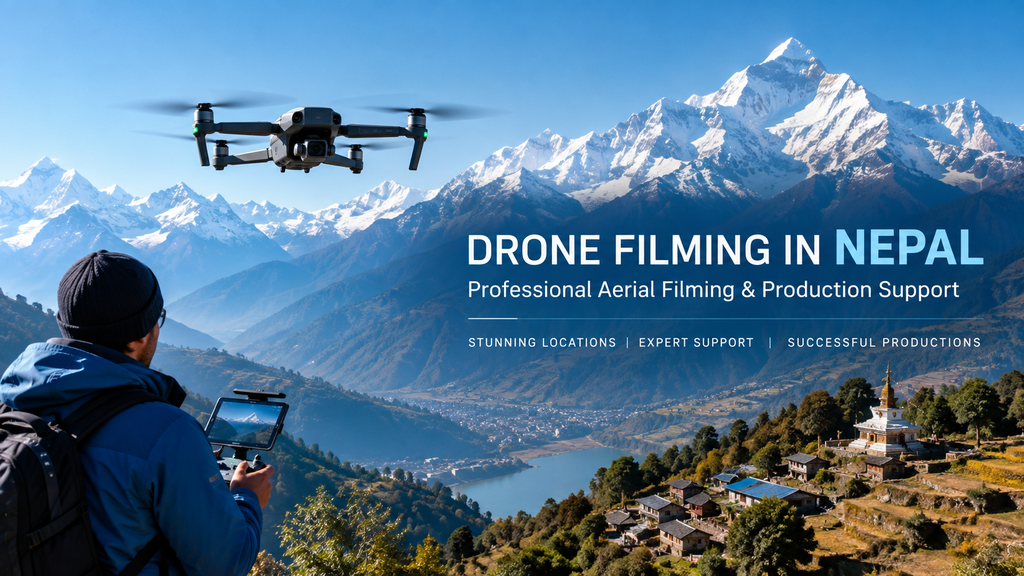
Drone Filming in Nepal – Professional Aerial Filming & Production Support
Nepal is one of the world's most spectacular destinations for drone filming and aerial cinematography. From the towering Himalayas and dramatic mountain valleys to ancient cities, lakes, forests, rivers, and remote landscapes, Nepal offers exceptional locations for filmmakers, documentary producers, television crews, commercial productions, and international media projects.
Peak Promotion provides professional drone filming and production support in Nepal, helping production teams with location planning, permit coordination, logistics, local coordination, and filming arrangements.
Whether you are planning a documentary in the Everest region, a commercial around Pokhara, a travel production in Mustang, or a larger international shoot requiring Himalayan logistics, professional preparation is essential.
Why Choose Nepal for Drone Filming?
Nepal offers remarkable geographical and cultural diversity within a relatively small area. A single production can capture snow-covered Himalayan peaks, high-altitude landscapes, traditional villages, lush forests, rivers, lakes, temples, historic cities, and modern urban environments.
This geographical diversity gives filmmakers the opportunity to create different visual environments without necessarily traveling between multiple countries.
Popular aerial filming environments include:
- Mount Everest and the Everest region
- Annapurna and Manaslu regions
- Langtang and Helambu
- Pokhara and Phewa Lake
- Kathmandu Valley
- Mustang and high-altitude landscapes
- Remote Himalayan villages
- Rivers, waterfalls, forests, and national parks
- Ancient temples, monasteries, and heritage sites
These diverse locations make Nepal an excellent destination for cinematic aerial footage, travel films, documentaries, commercials, television productions, and promotional videos.
Nepal's Visual Diversity at a Glance
| Environment | Potential Production Use |
| Himalayan peaks | Documentary, adventure, commercial |
| Mountain valleys | Establishing shots, travel films |
| Lakes and rivers | Tourism, lifestyle, commercial |
| Traditional villages | Cultural documentaries |
| Temples and monasteries | Heritage and cultural productions |
| Forests and waterfalls | Nature and adventure films |
| High-altitude landscapes | Expedition and outdoor productions |
| Kathmandu Valley | Architecture, heritage, urban storytelling |
The combination of mountains, culture, wildlife, architecture, and adventure makes Nepal particularly attractive for productions that depend on strong establishing shots and landscape storytelling.
Professional Drone Filming Support in Nepal
Drone operations in Nepal require proper planning and compliance with applicable aviation, filming, conservation, and local regulations. Requirements can vary according to the filming location, type of production, equipment, and flight operation.
Peak Promotion can assist production teams with practical arrangements required for filming in Nepal.
1. Drone Filming Permit Assistance
We help production teams understand and coordinate the necessary permissions for drone operations and filming. Requirements can vary according to the filming location and project, so early planning is recommended.
For productions involving restricted, protected, heritage, or high-altitude locations, advance coordination is particularly important.
Our role can include helping production teams identify the permissions and coordination required before the crew travels to the filming location.
2. Location Scouting
Choosing the right filming location can have a significant impact on the final production.
Our local team can help identify suitable locations for aerial filming based on the creative requirements of the production.
Potential environments include:
- Himalayan viewpoints
- Mountain valleys
- Traditional villages
- Lakes and rivers
- Monasteries and temples
- Forest landscapes
- High-altitude locations
- Cultural and heritage locations
Local knowledge can also help production teams understand access conditions, travel times, terrain, seasonal considerations, and logistical challenges before committing to a location.
3. Local Production Coordination
Working in remote areas of Nepal requires reliable local coordination.
Peak Promotion can help coordinate local staff, guides, transportation, accommodation, equipment movement, and other logistical requirements.
This can be particularly valuable for international crews unfamiliar with Nepal's geography, transportation network, mountain terrain, and local operating conditions.
4. High-Altitude Filming Support
Filming in the Himalayas can involve challenging terrain, unpredictable weather, altitude, and limited infrastructure.
Our experience in Himalayan logistics can support productions working in areas such as Everest, Annapurna, Manaslu, Langtang, Mustang, and other remote regions.
High-altitude filming requires careful consideration of:
- Crew movement
- Acclimatization
- Weather conditions
- Equipment transportation
- Accommodation availability
- Battery and power requirements
- Emergency planning
- Local transportation
- Communication limitations
Aerial filming should therefore be treated as part of the overall production logistics plan, rather than as an isolated technical activity.
5. Transportation and Logistics
Depending on the project, we can help arrange:
- Private vehicles
- 4WD transportation
- Domestic flights
- Helicopter logistics
- Porters and local staff
- Trekking crews
- Accommodation
- Equipment transportation
- Remote-location logistics
For productions carrying cameras, drones, batteries, tripods, lighting equipment, and other production gear, transportation planning becomes particularly important when locations are accessible only through trekking routes or remote roads.
6. Film Crew and Local Support
International production companies may require local guides, production assistants, location coordinators, translators, trekking staff, or experienced mountain personnel.
Peak Promotion can help production teams coordinate suitable local resources according to project requirements.
This allows international teams to maintain their creative and production direction while relying on local personnel for practical coordination on the ground.
Best Locations for Drone Filming in Nepal
Nepal offers a wide range of locations for aerial cinematography. The best location depends on the project's creative concept, accessibility, season, permissions, and logistical requirements.
▸ Everest Region
The Everest region provides some of the world's most iconic mountain scenery.
Aerial footage can showcase Himalayan peaks, glaciers, valleys, Sherpa settlements, monasteries, and trekking routes.
For adventure documentaries and expedition productions, the region can provide powerful establishing footage showing the scale and remoteness of the Himalayan environment.
Because of the region's altitude and complex terrain, however, weather, access, safety, and regulatory planning should be addressed well before the shoot.
▸ Annapurna Region
The Annapurna region offers an impressive combination of mountains, villages, forests, rivers, and high-altitude landscapes.
Pokhara and the surrounding region also provide excellent visual diversity, making the area suitable for tourism campaigns, documentaries, commercials, travel programs, and outdoor productions.
The contrast between lower-elevation landscapes and dramatic Himalayan backgrounds can provide particularly useful footage for storytelling.
▸ Mustang
Mustang is known for its dramatic barren landscapes, cliffs, ancient settlements, caves, monasteries, and distinctive Himalayan scenery.
It is particularly suitable for productions looking for a unique cinematic environment.
The region's distinctive landscape can provide visuals that differ considerably from the greener valleys and forests found elsewhere in Nepal.
▸ Pokhara
Pokhara offers mountains, lakes, waterfalls, forests, and surrounding hills.
The combination of Phewa Lake and the Annapurna range provides attractive opportunities for aerial cinematography.
Pokhara can also serve as a practical base for productions exploring nearby locations.
▸ Kathmandu Valley
The Kathmandu Valley combines historic architecture, temples, monasteries, traditional neighborhoods, and cultural heritage.
It can provide strong establishing shots for documentaries and travel productions.
For productions focused on Nepal's history and culture, aerial imagery can complement ground-level footage by showing the relationship between historic sites, neighborhoods, urban development, and surrounding landscapes.
▸ Manaslu Region
The Manaslu region offers spectacular mountain scenery, deep valleys, traditional villages, rivers, suspension bridges, and remote Himalayan landscapes.
It can be particularly suitable for productions seeking a less urbanized and more remote Himalayan visual setting.
How to Plan a Drone Filming Project in Nepal?
A successful aerial production begins long before the drone takes off.
Production companies should consider the project in several stages:
Creative Planning → Location Research → Permission Planning → Logistics → Crew Coordination → Equipment Preparation → Field Production → Post-Production
Step 1: Define the Creative Objective
Start by identifying what the aerial footage needs to communicate.
For example:
- A tourism campaign may need scenic establishing shots.
- A documentary may require geographic context.
- A commercial may require specific cinematic movements.
- An expedition film may need footage showing scale and terrain.
- A travel film may need a combination of landscapes and cultural locations.
A clear creative objective makes location scouting and production planning much more efficient.
Step 2: Identify Suitable Locations
The location should match both the creative concept and practical requirements.
Consider:
- Landscape
- Accessibility
- Season
- Weather
- Altitude
- Crew requirements
- Equipment requirements
- Permissions
- Nearby accommodation
- Transportation
Step 3: Plan Permissions Early
Drone operations and filming may involve different permissions depending on the location and production.
Do not assume that permission for filming automatically means permission for drone operations.
Production teams should identify applicable requirements before arriving in Nepal.
Step 4: Build a Logistics Plan
A remote aerial production may require considerably more planning than an urban shoot.
The logistics plan can include:
- Crew transportation
- Equipment transportation
- Accommodation
- Guides
- Porters
- Trekking staff
- Local coordination
- Communication
- Weather contingencies
- Emergency planning
Step 5: Prepare for Field Conditions
Mountain environments can change quickly.
Production teams should prepare for variations in:
- Wind
- Temperature
- Visibility
- Rain or snowfall
- Terrain
- Altitude
- Battery performance
- Access conditions
Having contingency plans helps reduce the risk of losing valuable production days.
Drone Filming vs. Traditional Ground Filming
Drone footage works best when it complements rather than replaces conventional cinematography.
| Ground Filming | Drone Filming |
| Captures people and close details | Captures large-scale landscapes |
| Strong for interviews | Strong for establishing shots |
| Shows ground-level perspective | Shows elevated perspective |
| Useful for cultural details | Useful for geography and scale |
| Works well in enclosed environments | Works best where flight is appropriate |
Combining the two approaches can create a more complete visual story.
For example, a documentary about a Himalayan village might combine drone establishing footage of the surrounding valley, ground-level footage of the village, interviews with residents, and trekking sequences.
Drone Filming for Different Types of Productions
Professional aerial footage can support a wide variety of production formats.
▸ Documentary Filming
Documentaries can use aerial cinematography to establish geography, show remote communities, introduce landscapes, and create transitions between locations.
▸ Commercial Productions
Tourism boards, travel companies, outdoor brands, hotels, and other businesses can use aerial footage to showcase destinations and experiences.
▸ Television Productions
Television crews may use aerial footage for opening sequences, location transitions, travel programs, news features, and documentary programming.
▸ Feature Films
Feature productions may require aerial establishing shots, landscape sequences, location transitions, and specialized production support.
▸ Travel Films
Nepal's mountains, lakes, temples, villages, and trekking routes provide extensive opportunities for travel-focused visual storytelling.
▸ Promotional Videos
Hotels, resorts, tourism businesses, destination-management companies, and outdoor brands can use aerial footage to communicate the scale and character of a location.
Drone Filming for International Productions
Nepal is attractive for international filmmakers because of its natural and cultural diversity. However, filming in remote mountain environments requires more than simply bringing a drone and camera.
A successful production may require:
Pre-production → Permit Planning → Location Scouting → Crew Coordination → Transportation → Drone Operation → Safety Management → Production Support
Peak Promotion can assist production companies throughout the planning and field-production process.
For international crews, having a local production partner can help simplify communication and coordination between the overseas production team and local resources.
Drone Filming Safety in Nepal
Safety should always be a priority when operating drones in Nepal, particularly in mountainous and remote environments.
Production teams should consider:
- Weather and wind conditions
- Altitude and temperature
- Mountain terrain
- Aviation restrictions
- Restricted and sensitive areas
- National park and conservation regulations
- Crowded locations
- Cultural and heritage sites
- Local community considerations
- Battery and equipment transportation
- Emergency and contingency planning
Professional planning helps reduce delays and allows the production team to focus on capturing high-quality footage.
Drone operations should always be conducted by appropriately qualified personnel and in accordance with applicable requirements.
Seasonal Considerations for Aerial Filming
Nepal's seasons can significantly influence filming conditions.
| Season | General Production Consideration |
| Spring | Mountain landscapes and generally favorable trekking conditions in many areas |
| Summer/Monsoon | Rain, clouds and changing visibility can affect outdoor filming |
| Autumn | Often attractive conditions for mountain and landscape productions |
| Winter | Cold temperatures and snow can create distinctive visuals but may increase logistical challenges |
The ideal filming period depends heavily on location, altitude, creative requirements, and weather conditions.
For Himalayan productions, it is useful to build flexibility into the schedule rather than relying on a single fixed filming day.
Challenges of Drone Filming in the Himalayas
Mountain aerial filming can create challenges that are less common in conventional productions.
▸ Weather
Mountain weather can change quickly, potentially affecting visibility and flight conditions.
▸ Terrain
Deep valleys, steep slopes, ridgelines, and remote locations require careful operational planning.
▸ Altitude
High-altitude environments can create additional challenges for both people and equipment.
▸ Access
Some filming locations require trekking, 4WD transportation, domestic flights, or other specialized logistics.
▸ Power and Batteries
Remote locations may have limited access to electricity, making battery planning important.
▸ Communication
Mobile connectivity and other communication services may not be consistently available in remote areas.
These challenges reinforce the value of having a local production and logistics partner involved from the planning stage.
Why Work with Peak Promotion?
Established in 1992, Peak Promotion is a Nepal-based company with extensive experience in film production support, expedition logistics, trekking, mountaineering, and Himalayan operations.
Our local experience allows us to support productions that require reliable coordination in both urban and remote environments.
Our Strengths:
- More than three decades of experience in Nepal
- Local knowledge of Himalayan destinations
- Film production and logistics support
- Location scouting assistance
- Permit coordination support
- Trekking and mountain logistics
- Experienced local guides and staff
- Transportation and accommodation coordination
- Remote-location production support
- International production coordination
Our value extends beyond individual filming arrangements. We can help connect the different parts of a production—from location planning and local coordination to transportation and remote-area logistics.
What Can Peak Promotion Help Arrange?
Depending on your project requirements, production support can include:
| Requirement | Production Support |
| Location planning | Identification of suitable filming environments |
| Permit coordination | Assistance with understanding and coordinating requirements |
| Transportation | Vehicles, 4WD and other transport arrangements |
| Remote access | Trekking crews, porters and local staff |
| Accommodation | Coordination based on itinerary and location |
| Local crew | Guides, assistants and production support personnel |
| Mountain logistics | Support for high-altitude and remote productions |
| Equipment movement | Assistance with transporting production equipment |
| Location coordination | Local communication and practical arrangements |
| Production planning | Coordination between different field requirements |
The exact services can be adapted according to the size, duration, location, and creative requirements of the production.
Planning an International Drone Production in Nepal
International production teams often have to coordinate multiple moving parts before arriving in Nepal.
A practical workflow can look like this:
1. Project Brief
Share the production concept, locations, dates, crew size, and equipment requirements.
2. Location Assessment
Identify suitable locations based on creative and logistical requirements.
3. Permission Planning
Review applicable filming and drone-operation requirements.
4. Production Schedule
Develop a realistic itinerary that accounts for transportation and field conditions.
5. Local Crew Coordination
Arrange guides, assistants, translators, production staff, or mountain personnel as required.
6. Transportation & Accommodation
Coordinate the movement of people and equipment.
7. Field Production
Support the production team during the filming period.
8. Contingency Management
Maintain alternatives for weather, access, transportation, or other unexpected issues.
This approach can help international crews spend less time dealing with logistical uncertainty and more time focusing on the creative production.
Drone Filming in Nepal: Production Checklist
Before traveling for an aerial production, consider preparing the following:
▸ Creative Requirements:
- Shot list
- Location requirements
- Required aerial perspectives
- Production schedule
- Reference footage or visual style
▸ Permissions:
- Filming requirements identified
- Drone-operation requirements reviewed
- Location-specific permissions checked
- Conservation or heritage requirements considered
▸ Logistics:
- Transportation
- Accommodation
- Local crew
- Guides
- Porters
- Equipment transportation
- Communication arrangements
▸ Safety:
- Weather monitoring
- Terrain assessment
- Emergency planning
- Battery planning
- Equipment protection
- Contingency schedule
A detailed checklist can reduce avoidable delays once the production team is in the field.
How Much Does Drone Filming in Nepal Cost?
The cost of drone filming in Nepal varies significantly depending on the production.
There is no single price that applies to every project because aerial filming can range from a short shoot around Kathmandu or Pokhara to a multi-week Himalayan production requiring trekking crews and remote logistics.
Factors that can influence project costs include:
- Number of filming days
- Location
- Altitude
- Crew size
- Equipment requirements
- Transportation
- Accommodation
- Local staff
- Trekking requirements
- Permit and coordination requirements
- Remote-area logistics
- Production complexity
For this reason, international production companies should provide their location, dates, crew size, filming objectives, and logistical requirements when requesting a production estimate.
Choosing a Drone Filming Partner in Nepal
When selecting a local partner, production companies should look beyond the ability to operate a drone.
A strong production partner should understand the wider requirements of filming in Nepal.
Consider whether the company can provide:
- Local location knowledge
- Production coordination
- Permit assistance
- Mountain logistics
- Transportation support
- Experienced local personnel
- Remote-location planning
- International production coordination
This broader approach can be especially important when filming outside major cities.
Frequently Asked Questions (FAQ's):
Q. Is drone filming possible in Nepal?
Drone filming can be possible in Nepal, but requirements depend on the operation, location, equipment, and applicable aviation and filming regulations. Production teams should plan permissions before filming.
Q. Do I need permission for drone filming in Nepal?
Depending on the operation and location, permissions may be required. Requirements can vary, so production teams should assess the specific project and location in advance.
Q. Can international film crews bring drones to Nepal?
International productions may be able to bring production equipment into Nepal, but equipment entry, filming, and drone-operation requirements should be reviewed and coordinated before travel.
Q. What are the best locations for drone filming in Nepal?
Popular filming environments include the Everest region, Annapurna, Mustang, Pokhara, Kathmandu Valley, Manaslu, and other Himalayan locations, subject to applicable permissions and operational conditions.
Q. Can drones be used for filming in the Everest region?
Aerial operations in the Everest region require particularly careful planning because of the area's altitude, terrain, aviation environment, conservation considerations, weather, and applicable regulations.
Q. Is Mustang suitable for aerial cinematography?
Mustang offers distinctive cliffs, valleys, settlements, monasteries, and high-altitude landscapes that can provide strong cinematic material. Production planning should account for access, weather, altitude, and location-specific requirements.
Q. Can Peak Promotion help with filming permits?
Peak Promotion can assist production teams with permit coordination and understanding the practical requirements associated with filming projects in Nepal.
Q. Can Peak Promotion arrange transportation for film crews?
Yes. Depending on the production, transportation support can include private vehicles, 4WD vehicles, domestic travel, helicopter logistics, and remote-location transportation.
Q. Can Peak Promotion support high-altitude filming?
Yes. Peak Promotion has experience in trekking, mountaineering, expedition logistics, and Himalayan operations and can help coordinate practical requirements for productions working in remote mountain environments.
Q. Can you help with location scouting in Nepal?
Yes. Location scouting assistance can help production teams identify suitable landscapes, villages, mountain areas, cultural locations, lakes, forests, and other environments based on their creative requirements.
Q. What type of productions can use drone filming services in Nepal?
Drone footage can support documentaries, feature films, television productions, commercials, travel films, promotional videos, music videos, tourism campaigns, and other visual productions.
Q. How far in advance should I plan a drone filming project?
Earlier planning is generally better, particularly for international productions, remote Himalayan locations, larger crews, and projects involving multiple permissions and logistical arrangements.
Q. Why use a local production partner for drone filming?
A local partner can provide location knowledge, logistical coordination, local communication, transportation support, crew coordination, and practical knowledge of remote environments, helping international productions operate more efficiently.
Plan Your Drone Filming Project in Nepal
Whether you are producing a documentary, feature film, television program, commercial, travel film, music video, promotional campaign, or aerial photography project, Nepal offers exceptional opportunities for visual storytelling.
From the Himalayas to ancient cities and from remote mountain villages to peaceful lakes, Nepal provides a diverse natural and cultural backdrop for professional aerial filming.
The key to a successful production is not simply finding an impressive landscape. It is combining the right location, permissions, equipment, crew, transportation, safety planning, and local support.
Peak Promotion can help make your production in Nepal professional, safe, efficient, and well coordinated.
Contact Peak Promotion for Drone Filming in Nepal
Planning an aerial filming project in Nepal?
Whether you need drone filming support, location scouting, permit coordination, transportation, mountain logistics, local crew coordination, or remote production support, Peak Promotion can help you plan the practical side of your project.
Peak Promotion Pvt. Ltd.
Contact: +977 9841135705
Email: info@peakpromotionnepal.com
Location: Lazimpat, Kathmandu 44600, Nepal
Peak Promotion – Your Trusted Film Production & Logistics Partner in Nepal.