Top 10 Mount Everest Climbers: Legendary Mountaineers & Record Holders
Mount Everest, rising to 8,848.86 meters (29,031.7 feet) above sea level, is the highest mountain on Earth. Known as Sagarmatha in Nepal and Chomolungma in Tibetan, Everest has challenged mountaineers for more than a century and remains one of the world's most recognized symbols of exploration and high-altitude mountaineering.
Since Sir Edmund Hillary and Tenzing Norgay made the first confirmed successful ascent on May 29, 1953, thousands of climbers have reached the summit. Yet certain mountaineers have become particularly notable because of historic firsts, extraordinary records, pioneering climbing techniques, or remarkable achievements in the face of physical challenges.
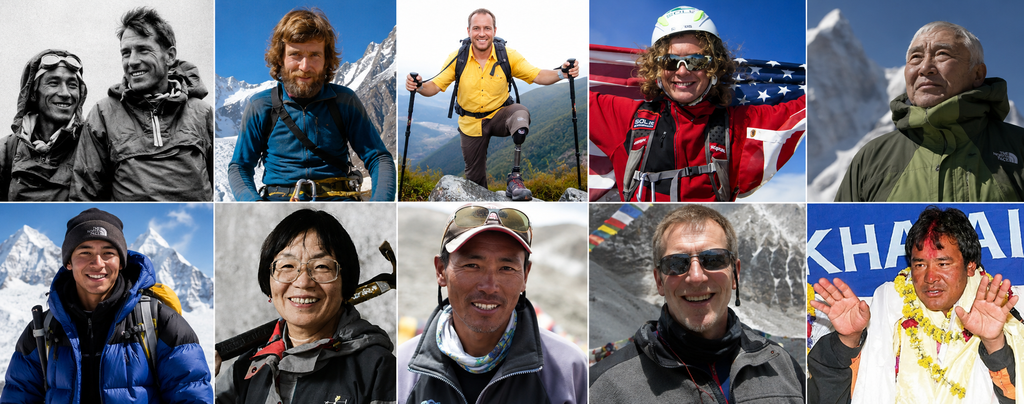
This list highlights 10 famous Mount Everest climbers whose achievements have had a significant place in Everest's mountaineering history.
The list is not intended as an objective ranking of who is the "best" climber. Instead, it brings together climbers known for historically important firsts, record-setting ascents, pioneering achievements, and contributions to the story of Mount Everest.
From the first climbers to stand on the summit to record-breaking Sherpa guides and adventurers who overcame extraordinary obstacles, these mountaineers have helped shape the history of the world's highest mountain.
Mount Everest at a Glance
| Fact | Details |
| Height | 8,848.86 m |
| Nepali name | Sagarmatha |
| Tibetan name | Chomolungma |
| First confirmed ascent | May 29, 1953 |
| First summit climbers | Edmund Hillary & Tenzing Norgay |
| Location | Nepal–China/Tibet border |
| First woman to summit | Junko Tabei |
| Most Everest ascents | Kami Rita Sherpa – 32 as of May 17, 2026 |
| Oldest man to summit | Yuichiro Miura – age 80 |
| First blind person to summit | Erik Weihenmayer |
Everest's officially recognized elevation of 8,848.86 meters was announced in 2020 following a joint Nepal-China measurement initiative.
1. Tenzing Norgay and Sir Edmund Hillary
The story of Mount Everest cannot begin anywhere else.
On May 29, 1953, Nepalese Sherpa mountaineer Tenzing Norgay and New Zealand mountaineer Sir Edmund Hillary became the first confirmed climbers to reach the summit of Mount Everest.
They were members of the 1953 British Mount Everest Expedition, led by Colonel John Hunt.
Their successful ascent represented the culmination of decades of attempts to reach the summit.
The pair reached the summit at approximately 11:30 a.m. and remained there for a relatively short period because of the extreme conditions. Their historic achievement established a new chapter in Himalayan mountaineering.
Hillary later became widely known for his mountaineering and humanitarian work in Nepal, particularly through the Himalayan Trust, which contributed to schools, hospitals, bridges and other community projects in the Khumbu region.
Tenzing Norgay became an enduring symbol of Sherpa mountaineering expertise and Himalayan exploration.
Why Their Everest Ascent Matters?
Their achievement was significant because they became the first confirmed climbers to reach the highest point on Earth.
Their ascent also demonstrated the importance of cooperation between international expedition members and highly experienced Himalayan climbers.
Key achievement: First confirmed ascent of Mount Everest, 1953.
Guinness World Records – Highest Mountain
Everest Expedition – Peak Promotion
2. Reinhold Messner
Italian mountaineer Reinhold Messner transformed perceptions of what was possible in high-altitude climbing.
In 1980, Messner became the first person to successfully climb Mount Everest solo and without supplemental oxygen.
He completed the ascent during the monsoon season, adding another layer of difficulty to an already demanding climb.
Messner was also the first mountaineer to successfully climb all 14 mountains higher than 8,000 meters, completing that achievement in 1986.
His climbing philosophy emphasized lightweight equipment, self-reliance and alpine-style approaches rather than relying on the large expedition infrastructure traditionally associated with Himalayan climbing.
Messner's Everest Legacy
Messner's Everest ascent demonstrated that the world's highest mountain could be climbed through an extremely minimalist approach.
His achievement became one of the defining milestones in the development of modern high-altitude mountaineering.
He subsequently became one of the most influential figures in mountaineering history through his expeditions, writing, museums and exploration work.
Key achievement: First solo ascent of Everest without supplemental oxygen, 1980.
Guinness World Records – Everest Records
3. Junko Tabei
Japanese mountaineer Junko Tabei made history on May 16, 1975, when she became the first woman to summit Mount Everest.
Tabei led the Japanese Women's Everest Expedition, which attempted the mountain from the Nepal side.
Her expedition faced serious challenges before the summit attempt. An avalanche struck the team's camp, and Tabei was buried beneath snow before being rescued by Sherpa team members.
Despite the setback, she continued the expedition.
Tabei eventually reached the summit with Sherpa guide Ang Tsering.
Her achievement became a landmark moment for women in mountaineering.
She later became the first woman to complete the Seven Summits, climbing the highest mountain on each continent.
Tabei's Legacy
Junko Tabei's Everest achievement helped challenge the perception that high-altitude mountaineering was primarily a male pursuit.
Her story continues to be associated with determination, exploration and the expanding role of women in mountaineering.
Key achievement: First woman to summit Mount Everest, 1975.
Guinness World Records – Everest History
4. Erik Weihenmayer
American adventurer Erik Weihenmayer became the first blind person to reach the summit of Mount Everest in 2001.
Weihenmayer lost his eyesight as a child, but continued pursuing demanding outdoor adventures.
Reaching Everest's summit required extensive preparation and a highly coordinated team.
His climb demonstrated the importance of teamwork, communication, route awareness and specialized adaptation in high-altitude environments.
Rather than treating blindness as the defining limitation of the expedition, Weihenmayer and his team developed methods that allowed him to navigate complex terrain.
Beyond Everest
Weihenmayer continued pursuing major adventure challenges after Everest and became a prominent advocate for people with disabilities.
His Everest achievement remains one of the most notable examples of adaptive mountaineering.
Key achievement: First blind person to summit Mount Everest, 2001.
5. Mark Inglis
New Zealand mountaineer Mark Inglis became the first double amputee to summit Mount Everest in 2006.
Inglis had lost both legs below the knees after becoming trapped in a snow cave on Mount Cook in New Zealand in 1982.
He subsequently learned to use specialized prosthetic limbs and continued pursuing demanding outdoor activities.
His Everest expedition presented additional technical and physical challenges.
At high altitude, one of his prosthetic legs was damaged during the expedition. He repaired it and continued climbing.
Inglis eventually reached the summit, becoming the first person with bilateral leg amputations to achieve the feat.
Why His Story Is Significant?
Inglis's achievement demonstrated how adaptive equipment, preparation, teamwork and persistence can expand the possibilities of high-altitude adventure.
His climb became an important milestone in the history of adaptive mountaineering.
Key achievement: First double amputee to summit Mount Everest, 2006.
6. Yuichiro Miura
Japanese mountaineer Yuichiro Miura became the oldest man to summit Mount Everest when he reached the top on May 23, 2013, at the age of 80 years and 223 days.
This was not Miura's first Everest record.
He had previously reached Everest's summit at ages 70 and 75, making his 2013 achievement his third time breaking the age record.
Guinness World Records currently recognizes Miura's 2013 ascent as the record for the oldest man to climb Everest.
His achievement was particularly notable because he continued mountaineering despite significant health challenges and previous heart surgeries.
Miura's Everest story illustrates that mountaineering goals can remain important throughout different stages of life.
A Record That Still Stands
As of 2026, Yuichiro Miura remains recognized by Guinness World Records as the oldest man to climb Mount Everest, having reached the summit at 80 years and 223 days.
Key achievement: Oldest man to summit Everest, 80 years and 223 days old.
Guinness World Records – Yuichiro Miura
7. Jordan Romero
American climber Jordan Romero became the youngest person to reach the summit of Mount Everest in 2010, at the age of 13.
He reached the summit from the northern, Tibetan side of the mountain with an expedition team that included family members and experienced guides.
Romero had already developed considerable climbing experience before attempting Everest and had trained for the expedition over an extended period.
His Everest climb attracted international attention because of his age and because it formed part of a larger goal of climbing the highest mountains on all seven continents.
The Youngest Everest Summiteer
Romero's achievement remains one of the most recognizable youth records associated with Everest.
His expedition also generated discussion about the physical, developmental and ethical considerations surrounding very young climbers attempting extremely high-altitude mountains.
Key achievement: Youngest person to summit Mount Everest, 13 years old, 2010.
8. Kami Rita Sherpa
Few people have a closer professional relationship with Mount Everest than Kami Rita Sherpa.
Born in the Solukhumbu region of Nepal, Kami Rita began working in the Everest climbing industry at a young age.
He reached Everest's summit for the first time in 1994.
Over the following decades, he continued returning to the mountain as a professional high-altitude guide.
In May 2026, Kami Rita reached the summit for the 32nd time, extending his own world record for the most Everest ascents. Guinness World Records lists his 32nd ascent as taking place on May 17, 2026, at age 56.
His first Everest ascent took place on May 13, 1994, and he has climbed the mountain nearly every year when expeditions were permitted.
More Than an Everest Record
Kami Rita's importance to Everest history extends beyond the number of summits.
His career reflects the central role of Sherpa mountain guides in Himalayan expeditions.
Sherpa teams perform essential work including:
- Route preparation
- Equipment transportation
- Rope fixing
- Camp logistics
- Client support
- High-altitude guiding
- Expedition safety
- Mountain rescue assistance
In 2026, Kami Rita's 32nd ascent further extended a record that has been associated with his name for years.
Key achievement: Most successful ascents of Mount Everest – 32 as of May 17, 2026.
Guinness World Records – Kami Rita Sherpa
Peak Promotion's Everest Expedition
9. Scott Parazynski
American astronaut, physician and mountaineer Scott Parazynski achieved a unique combination of exploration milestones.
On May 20, 2009, Parazynski became the first astronaut to summit Mount Everest.
Before reaching Everest's summit, he had already completed five NASA Space Shuttle missions and seven spacewalks.
His first attempt to climb Everest had been interrupted by a back injury, but he returned to the mountain and successfully completed the climb in 2009.
Guinness World Records recognizes him as the first astronaut to summit Everest.
From Space to the Summit
Parazynski's career connects two dramatically different forms of exploration:
- Human spaceflight
- High-altitude mountaineering
Few explorers have experienced both environments.
His Everest ascent therefore occupies a distinctive place in the history of mountain exploration.
Key achievement: First astronaut to summit Mount Everest, 2009.
Guinness World Records – Scott Parazynski
10. Babu Chiri Sherpa
Nepali mountaineer Babu Chiri Sherpa was one of the most accomplished Everest climbers of his generation.
He reached Everest's summit 10 times between 1990 and 2000.
Babu Chiri was also associated with several remarkable Everest records.
In 1999, he reportedly spent approximately 21 hours on the summit without supplemental oxygen, an extraordinary feat under conditions where exposure to the mountain environment is extremely dangerous.
He also set a rapid Everest ascent record, reaching the summit from Base Camp in 16 hours and 56 minutes.
His achievements helped establish him as one of Nepal's notable high-altitude mountaineers.
A Lasting Everest Legacy
Babu Chiri's story is closely connected with Nepal's Sherpa mountaineering tradition.
His achievements demonstrated the extraordinary endurance required to operate repeatedly at high altitude.
Although his life was tragically cut short by an accident on Everest in 2001, his name remains part of Nepal's mountaineering history.
Key achievements: 10 Everest summits and notable speed and endurance records.
Everest Climbers and the Records They Made
The achievements of these 10 mountaineers illustrate how diverse Everest's mountaineering history has become.
| Climber | Nationality / Background | Notable Everest Achievement |
| Tenzing Norgay | Nepalese Sherpa | First confirmed Everest ascent, 1953 |
| Edmund Hillary | New Zealand | First confirmed Everest ascent, 1953 |
| Reinhold Messner | Italian | First solo Everest ascent without supplemental oxygen, 1980 |
| Junko Tabei | Japanese | First woman to summit Everest, 1975 |
| Erik Weihenmayer | American | First blind person to summit Everest, 2001 |
| Mark Inglis | New Zealand | First double amputee to summit Everest, 2006 |
| Yuichiro Miura | Japanese | Oldest man to summit Everest, age 80 |
| Jordan Romero | American | Youngest Everest summiteer, age 13 |
| Kami Rita Sherpa | Nepalese Sherpa | Most Everest ascents, 32 as of 2026 |
| Scott Parazynski | American | First astronaut to summit Everest, 2009 |
| Babu Chiri Sherpa | Nepalese Sherpa | 10 Everest summits and notable speed/endurance records |
Note: Tenzing Norgay and Edmund Hillary are presented together because their 1953 achievement was a joint first ascent.
The Sherpa Contribution to Everest Mountaineering
Any discussion of famous Everest climbers should also recognize the enormous contribution of Sherpa mountaineers.
Sherpa guides have played a central role in Himalayan expeditions since the earliest attempts to climb Everest.
Their responsibilities can include:
- Carrying expedition equipment
- Establishing camps
- Fixing ropes
- Crossing difficult sections
- Supporting acclimatization rotations
- Guiding climbers
- Managing high-altitude logistics
- Assisting during emergencies
Kami Rita Sherpa's 32 Everest ascents provide one of the clearest examples of this professional mountaineering tradition.
Babu Chiri Sherpa's career represents another important chapter in the history of Nepali high-altitude mountaineering.
The achievements of these climbers demonstrate that Everest history is not solely a story of international expedition members. It is also deeply connected to the expertise and experience of Nepal's mountain communities.
Why Everest Continues to Inspire Climbers?
More than 70 years after Hillary and Tenzing reached the summit, Mount Everest continues to attract climbers from around the world.
For some, the objective is the summit itself.
For others, Everest represents:
- Personal achievement
- Exploration
- Adventure
- Scientific interest
- Cultural connection
- Professional mountaineering
- A lifelong goal
But Everest remains an exceptionally demanding mountain.
Altitude, weather, cold, steep terrain, crevasses, avalanches, route conditions and limited oxygen all contribute to the challenge.
The achievements of famous Everest climbers should therefore not be interpreted as evidence that the mountain has become easy.
Instead, their records demonstrate how preparation, experience, teamwork, technology, acclimatization and mountain expertise have evolved over the decades.
From the First Ascent to Modern Everest Expeditions
Everest climbing has changed significantly since 1953.
The equipment available to climbers today is substantially more advanced.
Modern expeditions can use:
- Advanced climbing clothing
- High-altitude communications
- GPS and navigation technology
- Specialized oxygen systems
- Modern tents
- Lightweight climbing equipment
- Weather forecasting
- Satellite communication
- Professional expedition logistics
- Helicopter-supported rescue capabilities
Yet the fundamental challenge remains.
The summit is still located at 8,848.86 meters, where the human body operates under extreme physiological stress.
That is why professional expedition planning remains essential.
For those interested in understanding what a modern Everest expedition involves, Peak Promotion provides dedicated Mount Everest Expedition services covering expedition logistics, Sherpa support, acclimatization planning and other operational requirements.
Everest Base Camp and the Journey Before the Summit
Not everyone who wants to experience Everest intends to climb to the summit.
The Everest Base Camp Trek allows trekkers to travel through the Khumbu region and experience the landscapes, villages and mountain culture surrounding the world's highest peak without undertaking a technical Everest summit expedition.
The route provides views of Everest and access to iconic locations throughout the Khumbu.
For those interested in exploring the region, see Peak Promotion's Everest Base Camp Trek.
The trek also provides insight into the environment in which many of Everest's historic expeditions have taken place.
The Importance of Preparation for Everest
The stories of famous Everest climbers can be inspiring, but they also highlight the importance of preparation.
A successful Everest expedition requires much more than physical fitness.
Climbers need to consider:
• Physical Preparation
Long periods of walking, climbing and carrying equipment require endurance and strength.
• Altitude Acclimatization
The body needs time to adapt to decreasing oxygen availability at high elevations.
• Technical Skills
Depending on the route and conditions, climbers need skills in areas such as rope work, crampon use, glacier travel and high-altitude movement.
• Mental Preparation
Everest expeditions can involve weeks of challenging conditions, uncertainty, cold and fatigue.
• Expedition Logistics
Food, oxygen, equipment, camps, communications, transportation and mountain staff must all be coordinated.
• Weather
Summit attempts depend heavily on mountain conditions and weather windows.
These factors help explain why the achievements of historic Everest climbers remain remarkable.
Everest's Legacy of Exploration
From the first successful ascent in 1953 to Kami Rita Sherpa's 32nd summit in 2026, Everest's history is filled with milestones.
The climbers featured in this article represent different aspects of that history.
Hillary and Tenzing represent the historic first ascent.
Messner represents a revolution in high-altitude climbing style.
Tabei represents a landmark achievement for women in mountaineering.
Weihenmayer and Inglis demonstrate milestones in adaptive mountaineering.
Miura and Romero established notable age records.
Parazynski connected mountaineering with space exploration.
Babu Chiri represented Nepal's exceptional Sherpa mountaineering tradition.
And Kami Rita's continuing record demonstrates the extraordinary role of professional Sherpa guides in modern Everest expeditions.
Together, their stories show that Everest history is not defined by a single type of climber.
It is a history of firsts, records, perseverance, innovation, teamwork and mountain expertise.
Frequently Asked Questions (FAQ's):
Q. Who were the first people to climb Mount Everest?
Tenzing Norgay and Sir Edmund Hillary made the first confirmed successful ascent of Mount Everest on May 29, 1953.
Q. Who has climbed Mount Everest the most times?
As of May 17, 2026, Kami Rita Sherpa holds the record with 32 successful Everest ascents.
Q. Who was the first woman to climb Mount Everest?
Japanese mountaineer Junko Tabei became the first woman to summit Mount Everest on May 16, 1975.
Q. Who was the first blind person to summit Everest?
American adventurer Erik Weihenmayer became the first blind person to reach the summit in 2001.
Q. Who was the oldest person to climb Mount Everest?
Yuichiro Miura of Japan reached the summit at 80 years and 223 days on May 23, 2013. Guinness World Records recognizes this as the oldest male Everest ascent.
Q. Who was the youngest person to climb Mount Everest?
Jordan Romero of the United States reached the summit at age 13 in 2010.
Q. Who was the first double amputee to climb Everest?
New Zealand climber Mark Inglis became the first double amputee to summit Everest in 2006.
Q. Who climbed Everest without supplemental oxygen?
Reinhold Messner became the first person to climb Everest solo without supplemental oxygen in 1980.
Q. Who was the first astronaut to climb Mount Everest?
Former NASA astronaut Scott Parazynski became the first astronaut to summit Everest in 2009.
Q. How high is Mount Everest?
Mount Everest is 8,848.86 meters (29,031.7 feet) above sea level.
Q. Why are Sherpa climbers important to Everest expeditions?
Sherpa mountaineers provide essential expertise in high-altitude guiding, route preparation, equipment transportation, camp operations and expedition support.
Q. Can tourists climb Mount Everest?
Experienced climbers can join organized Everest expeditions, but reaching the summit requires extensive preparation, technical climbing ability, acclimatization and professional expedition support. It is substantially more demanding than trekking to Everest Base Camp.
Q. Can I visit Everest without climbing it?
Yes. The Everest Base Camp Trek allows visitors to travel through the Khumbu region and reach Everest Base Camp without attempting a summit of Mount Everest.
Explore the Everest Base Camp Trek with Peak Promotion
Plan Your Own Everest Adventure
The achievements of legendary Everest climbers have inspired generations of adventurers to explore the Himalayas.
You do not have to summit Everest to experience its extraordinary environment.
For trekkers, the Everest Base Camp Trek provides an opportunity to explore the Khumbu region, Sherpa villages, monasteries and spectacular Himalayan landscapes.
For experienced mountaineers seeking the summit, a professional Everest Expedition requires extensive preparation, acclimatization, technical skills and reliable logistical support.
Peak Promotion provides trekking and mountaineering services in Nepal, including Everest-region trekking and expedition programs.
Everest Base Camp Trek – Peak Promotion
Mount Everest Expedition – Peak Promotion
For official information about Everest's geography, trekking and tourism in Nepal, readers can also consult the Nepal Tourism Board.
Conclusion: The Climbers Who Shaped Everest History
The history of Mount Everest is filled with remarkable people.
From Tenzing Norgay and Edmund Hillary's historic first ascent to Reinhold Messner's pioneering solo climb, Junko Tabei's breakthrough as the first woman, Erik Weihenmayer's achievement as the first blind climber, and Kami Rita Sherpa's record 32 Everest summits, each achievement represents a different chapter in the story of the world's highest mountain.
Their stories also demonstrate that Everest mountaineering is not defined by one particular background or type of achievement.
Some climbers made history through first ascents.
Others established records.
Some overcame physical challenges.
Others dedicated their careers to guiding and supporting people on the mountain.
Together, they have contributed to the continuing legacy of Mount Everest and the wider history of Himalayan mountaineering.
For today's adventurers, their achievements offer inspiration—but Everest remains a demanding and potentially dangerous environment that requires serious preparation, professional support and respect for the mountain.
The story of Everest continues, and every new expedition becomes another chapter in the history of the world's highest mountain.