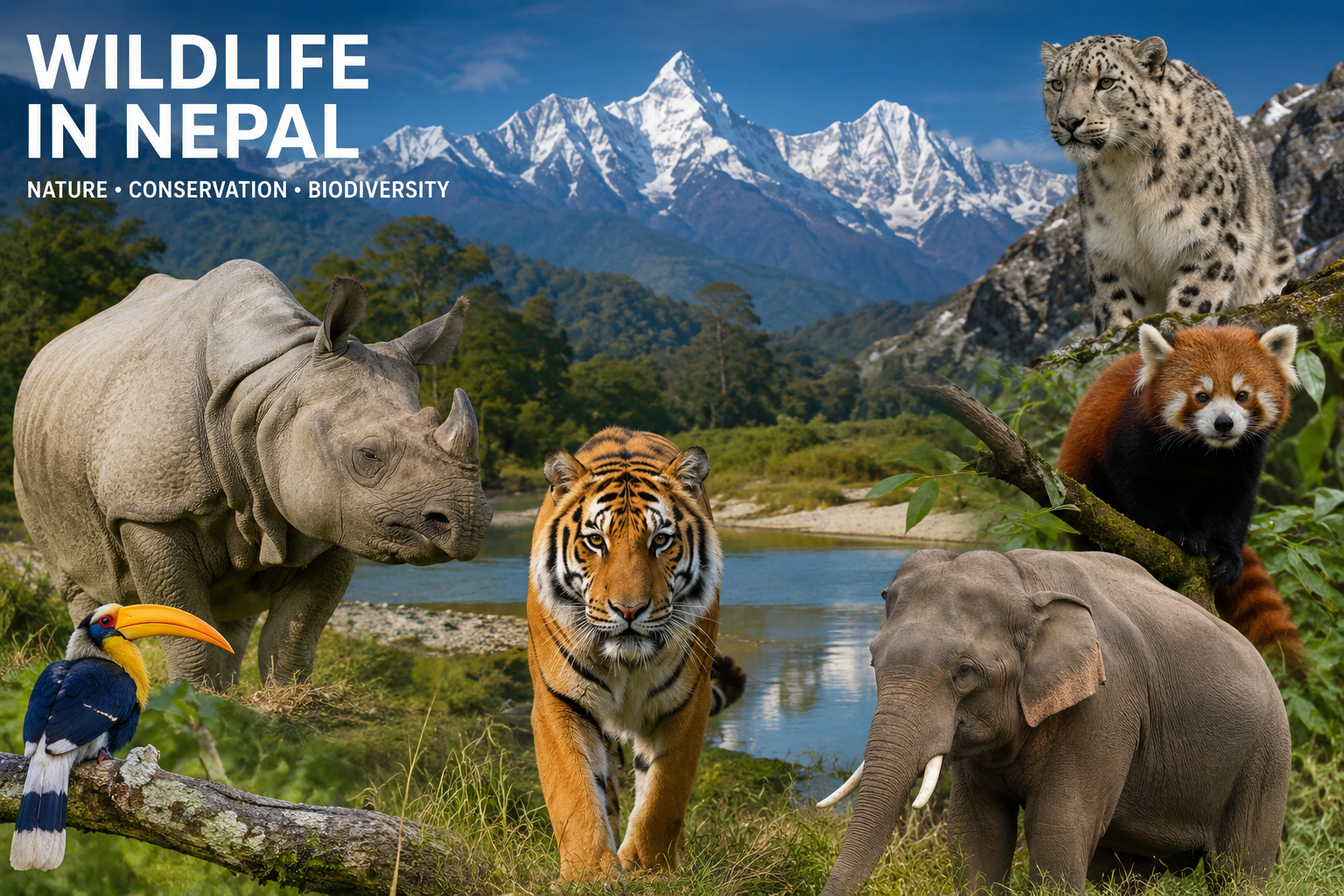
Wildlife in Nepal: Protecting Nature and Preserving Biodiversity
Nepal may be a relatively small country, but its extraordinary variation in altitude, climate, landscapes, and ecosystems makes it one of the most biologically diverse countries in the region. Wildlife in Nepal ranges from Bengal tigers and one-horned rhinoceroses in the subtropical Terai to snow leopards and Himalayan musk deer in high mountain ecosystems.
The country's landscape changes dramatically from the lowland plains to the Himalayas, creating habitats for a remarkable variety of mammals, birds, reptiles, amphibians, insects, plants, and other organisms. Nepal's protected-area network extends across ecosystems ranging from alluvial grasslands and tropical forests to high-altitude mountains and dry Himalayan rangelands. A Department of National Parks and Wildlife Conservation management strategy notes that Nepal's protected areas cover approximately 23.39% of the country's land area.
This diversity is not only important for wildlife. Healthy ecosystems support water resources, agriculture, livelihoods, tourism, climate resilience, and local communities. Conservation therefore involves much more than protecting individual animals—it also requires protecting habitats and maintaining the ecological relationships that allow species to survive.
From the forests of Chitwan and Bardia to the high-altitude landscapes of Sagarmatha, Langtang, and Shey Phoksundo, Nepal offers opportunities to experience nature in remarkably different environments. At the same time, growing tourism, habitat pressures, climate change, wildlife crime, and human-wildlife conflict make responsible conservation increasingly important.
Nepal's Remarkable Biodiversity
One of the defining characteristics of biodiversity in Nepal is the country's dramatic altitudinal variation.
Within a relatively short geographical distance, Nepal contains tropical and subtropical lowlands, mid-hill forests, temperate ecosystems, alpine landscapes, and high Himalayan environments. This creates ecological niches for species with very different habitat requirements.
The country's biodiversity includes:
- Bengal tigers
- Greater one-horned rhinoceroses
- Asian elephants
- Snow leopards
- Red pandas
- Musk deer
- Himalayan black bears
- Leopards
- Wild water buffalo
- Gharials
- Pangolins
- Numerous pheasant species
- Migratory and resident birds
- Diverse reptiles and amphibians
- Hundreds of butterfly and insect species
Nepal's conservation authorities have identified numerous species requiring targeted conservation action. Current and recent species-specific plans include conservation programs for tigers, rhinos, elephants, snow leopards, red pandas, blackbuck, Bengal floricans, gharials, pangolins, and other wildlife.
This demonstrates an important principle: wildlife conservation in Nepal is not focused on one iconic animal. It involves protecting entire ecosystems while developing targeted strategies for species facing particular threats.
Why Is Nepal So Rich in Wildlife?
Nepal's biodiversity can largely be explained by its combination of geography, altitude, climate, and habitat diversity.
The Terai contains forests, wetlands, grasslands, and river systems that provide habitat for species such as rhinos, tigers, elephants, crocodiles, deer, and numerous birds.
The mid-hills contain forests and agricultural landscapes that support species including leopards, bears, monkeys, pheasants, and smaller mammals.
Higher elevations provide increasingly specialized habitats. Alpine and Himalayan ecosystems support animals such as snow leopards, Himalayan tahr, blue sheep, musk deer, and red pandas in suitable habitats.
Nepal's Major Wildlife Zones
| Region | Major Habitats | Examples of Wildlife |
| Terai | Grasslands, riverine forests, wetlands | Tiger, rhino, elephant, gharial, deer |
| Chure & Siwalik | Sal forests, hills, river valleys | Leopard, deer, sloth bear, birds |
| Mid-Hills | Temperate and subtropical forests | Red panda, leopard, monkeys, pheasants |
| High Mountains | Alpine meadows and rocky landscapes | Snow leopard, blue sheep, Himalayan tahr |
| High Himalayas | Cold desert and alpine ecosystems | Snow leopard, musk deer, Himalayan birds |
This geographic diversity makes Nepal particularly important for conservation because protecting different landscapes can support species with very different ecological requirements.
Iconic Wildlife in Nepal
1. Bengal Tiger
The Bengal tiger is among Nepal's most recognizable wildlife species and one of the country's major conservation successes.
Tigers are primarily associated with the Terai's forests and grasslands, particularly protected landscapes such as Chitwan, Bardia, Parsa, and Shuklaphanta.
Nepal's 2022 national tiger assessment estimated 355 tigers across the country. The assessment documented population increases across Nepal's major tiger landscapes compared with earlier surveys.
The government also maintains a Tiger Conservation Action Plan for 2023–2032, reflecting the continued need for habitat protection, monitoring, prey management, anti-poaching measures, and management of human-tiger interactions.
Tiger conservation illustrates why protecting one species often requires protecting an entire ecosystem. Tigers need adequate habitat, prey, water, and connected landscapes to maintain viable populations.
2. Greater One-Horned Rhinoceros
The greater one-horned rhinoceros is another flagship species of wildlife in Nepal.
Chitwan National Park is particularly associated with rhino conservation. The 2021 national rhino count recorded 752 greater one-horned rhinoceroses in Nepal, including 694 in Chitwan, 38 in Bardia, 17 in Shuklaphanta, and 3 in Parsa.
The recovery of the rhino population demonstrates how habitat protection, anti-poaching measures, monitoring, and coordinated conservation programs can contribute to species recovery.
Nepal now has a Rhino Conservation Action Plan for 2024–2034, showing that conservation remains an ongoing process rather than a one-time achievement.
3. Snow Leopard
At the opposite end of Nepal's ecological spectrum is the elusive snow leopard.
Found in high mountain ecosystems, snow leopards are adapted to cold, rugged terrain and can be extremely difficult to observe. Their conservation is closely linked to maintaining healthy high-altitude ecosystems and prey populations.
Nepal has a Snow Leopard Conservation Action Plan for 2024–2030, reflecting continued national efforts to protect this species and its Himalayan habitat.
Snow leopard conservation also highlights the importance of working with communities living in mountain regions. Protecting wildlife in remote areas requires consideration of livestock, livelihoods, grazing patterns, habitat connectivity, and human-wildlife interactions.
4. Red Panda
The red panda is one of Nepal's most distinctive forest species.
It is associated primarily with temperate mountain forests where bamboo and suitable vegetation provide important habitat. The species is particularly sensitive to habitat fragmentation and other environmental pressures.
Nepal has developed species-specific conservation planning for red pandas, demonstrating the importance of protecting the forest ecosystems on which these animals depend.
For visitors, encountering a red panda is far less predictable than seeing larger animals such as rhinos during a safari. This is part of what makes wildlife observation in Nepal diverse: some species are visible in open grasslands, while others require specialized habitat and considerable patience.
Protected Areas: The Foundation of Wildlife Conservation in Nepal
Protected areas form the backbone of wildlife conservation in Nepal.
Nepal's protected-area network includes national parks, conservation areas, a wildlife reserve, a hunting reserve, and buffer zones. The country's protected areas represent ecosystems ranging from lowland Terai forests and grasslands to high Himalayan landscapes.
The National Parks and Wildlife Conservation Act provides an important legal foundation for protected-area and wildlife management in Nepal. The country's protected-area system began with the establishment of Chitwan National Park in 1973, Nepal's first national park.
Important Wildlife and Nature Destinations
| Protected Area | Known For | Major Experience |
| Chitwan National Park | Rhino, tiger, gharial, birds | Jungle safari and wildlife viewing |
| Bardia National Park | Tiger, elephant, rhino, birds | Wildlife safari and wilderness |
| Sagarmatha National Park | Himalayan ecosystem | Mountain landscapes and nature |
| Langtang National Park | Himalayan biodiversity | Trekking and wildlife observation |
| Shey Phoksundo National Park | High-altitude ecosystems | Remote Himalayan nature |
| Koshi Tappu | Wetlands and birds | Birdwatching and wetland ecology |
| Shivapuri Nagarjun National Park | Forest and birds near Kathmandu | Hiking, birdwatching and nature |
Nepal's official protected-area tourism platform identifies these areas as destinations for wildlife viewing, trekking, birdwatching, landscape appreciation, and nature-based recreation.
Chitwan National Park: A Major Wildlife Destination
Chitwan National Park is one of Nepal's most important wildlife destinations.
Established in 1973, it became Nepal's first national park. Its ecosystems include forests, grasslands, rivers, and wetlands, creating habitat for a wide range of wildlife.
The Department of National Parks and Wildlife Conservation reports more than 60 mammal species and more than 500 bird species in the park, alongside reptiles, amphibians, and other biodiversity. Chitwan was also designated a UNESCO World Heritage Site in 1984.
Visitors commonly explore the park through activities such as:
- Jeep safaris
- Jungle walks
- Birdwatching
- Canoe trips
- Nature interpretation
- Wildlife photography
- Community-based tourism
The experience is not simply about seeing a tiger or rhino. A well-managed visit can also help visitors understand forests, wetlands, wildlife behavior, and conservation challenges.
Bardia National Park and Nepal's Western Wildlife
Bardia National Park provides another important destination for Nepal wildlife tourism.
Located in western Nepal, Bardia contains extensive forests and grasslands and provides habitat for species including tigers, elephants, rhinos, deer, crocodiles, and many bird species.
Compared with more established tourist destinations, Bardia is often associated with a quieter wilderness experience. Its importance also demonstrates why wildlife tourism should not be concentrated around a single protected area.
Distributing tourism across appropriate destinations can help diversify local economic opportunities while encouraging broader appreciation of Nepal's protected landscapes.
Sagarmatha and Himalayan Wildlife
Wildlife conservation in Nepal is not limited to the tropical Terai.
Sagarmatha National Park represents an entirely different ecological environment. Located in the Everest region, the park contains high-altitude landscapes and is home to species adapted to extreme Himalayan conditions.
Visitors traveling through the Everest region may encounter Himalayan birds and mammals, although wildlife sightings can be less predictable than in lowland safari destinations.
This distinction is important when planning a wildlife-focused trip to Nepal:
Terai destinations are generally associated with large-mammal safari experiences, while Himalayan destinations combine wildlife with high-altitude landscapes, trekking, and mountain ecosystems.
The Role of Local Communities in Wildlife Conservation
Wildlife cannot be effectively protected through national parks alone.
Many protected areas are surrounded by communities whose livelihoods are connected to agriculture, forests, tourism, livestock, and natural resources. Conservation policies therefore need to consider the relationship between people and protected landscapes.
Nepal's protected-area management system includes buffer-zone approaches intended to connect conservation with local development and livelihoods. DNPWC describes mechanisms through which protected-area revenue can support conservation and community development activities around protected areas.
Community participation can support:
- Forest protection
- Wildlife monitoring
- Anti-poaching initiatives
- Tourism services
- Habitat restoration
- Environmental education
- Human-wildlife conflict management
- Local employment
- Sustainable resource use
This creates an important connection between wildlife conservation and sustainable tourism.
When communities see legitimate economic and social benefits from conservation, protected areas can become part of a broader local development strategy rather than being viewed only as restricted spaces.
Major Challenges Facing Wildlife in Nepal
Despite significant conservation progress, Nepal's wildlife continues to face challenges.
1. Habitat Loss and Fragmentation
Wildlife needs connected habitats for feeding, breeding, migration, and dispersal.
Roads, settlements, infrastructure development, agriculture, and other land-use changes can fragment habitats and make it harder for animals to move between populations.
Maintaining ecological corridors is therefore an important part of long-term conservation planning.
2. Human-Wildlife Conflict
As people and wildlife share increasingly limited landscapes, encounters can occur.
Crop damage, livestock losses, property damage, and risks to human safety can create significant challenges for communities living near wildlife habitats.
At the same time, retaliatory responses can threaten wildlife.
Effective conservation therefore requires practical approaches to human-wildlife conflict management, including prevention, rapid response, community participation, compensation mechanisms where applicable, and habitat planning.
3. Wildlife Crime and Poaching
Illegal hunting and wildlife trafficking remain conservation concerns.
Species with valuable body parts or illegal-market demand can become targets for poaching and trafficking.
Anti-poaching patrols, intelligence, law enforcement, community participation, monitoring technology, and cross-border cooperation are important tools for addressing this challenge.
4. Climate Change
Climate change can alter temperature, rainfall, vegetation, water availability, and the distribution of suitable habitats.
For high-altitude species, changing environmental conditions can shift habitats upward or alter relationships between species and their food sources.
Climate adaptation therefore needs to become an increasingly important part of biodiversity planning.
5. Unmanaged Tourism
Tourism can provide important economic benefits, but poorly managed tourism can also create environmental pressure.
Potential concerns include:
- Waste generation
- Disturbance to wildlife
- Noise
- Habitat damage
- Improper vehicle use
- Water consumption
- Unregulated construction
This is why responsible wildlife tourism is essential.
How Tourism Can Support Wildlife Conservation?
Tourism and conservation do not have to be opposing goals.
When appropriately managed, tourism can create employment, generate revenue, support local businesses, and increase public awareness about biodiversity.
Nepal's protected-area authorities specifically recognize nature-based tourism as an important way to promote appreciation and support for conservation.
A responsible wildlife tourism model can involve:
Protected area → Conservation management → Tourism revenue → Local employment → Community support → Stronger conservation
However, this relationship depends on good management.
Visitors should therefore choose responsible operators, respect park rules, avoid disturbing wildlife, minimize waste, and support local communities.
Responsible Wildlife Tourism in Nepal
If you plan to experience wildlife in Nepal, responsible behavior can make a meaningful difference.
• Respect Wildlife
Never attempt to approach, feed, chase, or provoke wild animals for photographs.
• Follow Park Rules
Protected areas have specific regulations governing vehicles, walking routes, photography, waste, and interactions with wildlife.
• Avoid Single-Use Plastics
Carry reusable water bottles and minimize unnecessary packaging.
• Do Not Remove Natural Materials
Avoid collecting plants, rocks, feathers, shells, or other natural materials from protected areas.
• Choose Responsible Operators
Use tourism companies and guides that follow park regulations and demonstrate responsible environmental practices.
• Support Local Communities
Choose locally owned accommodation, guides, restaurants, handicrafts, and other legitimate services where possible.
• Keep Noise Low
Wild animals depend on natural soundscapes for communication, feeding, and awareness of predators.
• Avoid Wildlife Entertainment
Responsible wildlife tourism should prioritize observing animals in appropriate natural environments rather than supporting activities that exploit or stress them.
Conservation Is More Than Protecting Individual Animals
One of the most important ideas in modern conservation is that protecting a species requires protecting the ecosystem around it.
For example, protecting a tiger means more than protecting individual tigers. Tigers require prey, water, forests, grasslands, territory, and connected habitats.
Similarly, protecting rhinos requires maintaining grasslands, wetlands, forests, water systems, and effective protection from poaching.
The same principle applies to snow leopards, red pandas, elephants, birds, reptiles, amphibians, and countless less-visible species.
Nepal's biodiversity strategy recognizes biodiversity as important not only for wildlife itself but also for ecosystem services, livelihoods, agriculture, water resources, food security, and human well-being.
Nepal's Conservation Progress and the Road Ahead
Nepal's conservation history provides several important examples of wildlife recovery.
The growth of the rhino population from 645 in 2015 to 752 in the 2021 national count is one example.
Similarly, the 2022 tiger assessment estimated 355 tigers nationally, reflecting substantial population growth compared with earlier national surveys.
These achievements demonstrate that coordinated conservation can produce measurable results.
But conservation cannot stop after a population increases.
Species still require:
- Long-term habitat protection
- Scientific monitoring
- Anti-poaching programs
- Community participation
- Wildlife corridors
- Human-wildlife conflict management
- Climate adaptation
- Responsible tourism
- Strong conservation laws
- International cooperation
Nepal continues to maintain species-specific conservation plans, including recent plans for rhinos, elephants, snow leopards, tigers, and other threatened species.
Wildlife in Nepal: A Quick Overview
| Topic | Key Information |
| Major ecosystems | Terai, Chure, mid-hills, alpine and Himalayan regions |
| Iconic mammals | Tiger, rhino, elephant, snow leopard, red panda |
| Major wildlife destinations | Chitwan, Bardia, Sagarmatha, Langtang, Shey Phoksundo |
| Protected-area coverage | Approximately 23.39% of Nepal's land area according to DNPWC's protected-area management strategy |
| 2021 rhino count | 752 greater one-horned rhinos |
| 2022 tiger estimate | 355 tigers |
| Major conservation challenges | Habitat fragmentation, wildlife crime, climate change, human-wildlife conflict |
| Tourism opportunity | Safaris, trekking, birdwatching, nature tourism |
| Conservation approach | Protected areas, species action plans, community participation and responsible tourism |
Frequently Asked Questions (FAQ's):
Q. What are the most famous wild animals in Nepal?
Some of the best-known animals include the Bengal tiger, greater one-horned rhinoceros, Asian elephant, snow leopard, red panda, leopard, musk deer, Himalayan tahr, gharial, and wild water buffalo.
Q. Where can I see wildlife in Nepal?
Chitwan and Bardia are particularly well known for lowland wildlife and safari experiences. Himalayan protected areas such as Sagarmatha, Langtang, and Shey Phoksundo offer opportunities to experience high-altitude ecosystems.
Q. What is the most famous national park for wildlife in Nepal?
Chitwan National Park is one of Nepal's most prominent wildlife destinations and was the country's first national park, established in 1973. It is particularly known for rhinos, tigers, crocodiles, deer, birds, and diverse forest ecosystems.
Q. How many rhinos are there in Nepal?
The most recent nationwide rhino count cited by Nepal's conservation organizations recorded 752 greater one-horned rhinoceroses in 2021.
Q. How many tigers are there in Nepal?
Nepal's 2022 national tiger assessment estimated 355 tigers. Future surveys may update this figure, so population numbers should always be associated with the relevant survey year.
Q. Is wildlife tourism important to Nepal?
Yes. Protected areas are important nature-based tourism destinations and tourism can contribute to local employment, community livelihoods, environmental awareness, and conservation support when properly managed.
Q. What is the biggest threat to wildlife in Nepal?
There is no single threat affecting every species. Habitat fragmentation, human-wildlife conflict, wildlife crime, environmental change, and climate-related pressures can affect different species and ecosystems in different ways.
Q. How does Nepal protect endangered animals?
Nepal uses protected areas, species-specific conservation action plans, wildlife monitoring, anti-poaching measures, habitat management, legislation, and community-based conservation approaches.
Q. What can tourists do to protect wildlife?
Tourists can follow park regulations, avoid disturbing animals, reduce waste, avoid feeding wildlife, choose responsible tourism operators, respect local communities, and support legitimate conservation-oriented tourism activities.
Q. Can I see a snow leopard in Nepal?
Snow leopards occur in Nepal's high mountain regions, but sightings are difficult because they are elusive and live in rugged environments. Wildlife observation in these areas requires patience, appropriate guides, and respect for the animal's habitat.
Q. Is Nepal good for birdwatching?
Yes. Nepal's wide range of ecosystems supports a large variety of resident and migratory bird species. Wetlands, forests, grasslands, and Himalayan environments provide different birdwatching opportunities.
Q. Why is biodiversity important to Nepal?
Biodiversity supports ecosystems and contributes to livelihoods, agriculture, water resources, tourism, environmental stability, and cultural and ecological values. Nepal's biodiversity strategy recognizes these connections between biodiversity and human well-being.
Q. How can local communities participate in wildlife conservation?
Communities can participate through buffer-zone programs, forest management, tourism, wildlife monitoring, habitat protection, conservation awareness, and activities designed to reduce human-wildlife conflict.
Conclusion: Protecting Nepal's Wildlife for Future Generations
Wildlife in Nepal represents far more than a collection of rare and beautiful animals. It is part of a complex network of forests, grasslands, wetlands, rivers, mountains, communities, and ecosystems that supports both nature and people.
From the greater one-horned rhinoceros of Chitwan to the Bengal tiger of the Terai and the elusive snow leopard of the Himalayas, Nepal's wildlife demonstrates the extraordinary ecological diversity of the country.
Conservation achievements, including the recovery of rhino and tiger populations, show what coordinated protection, scientific monitoring, community participation, and effective management can accomplish. At the same time, continuing challenges such as habitat fragmentation, wildlife crime, human-wildlife conflict, climate change, and unmanaged tourism require sustained attention.
The future of Nepal wildlife conservation depends on cooperation between government agencies, conservation organizations, local communities, tourism businesses, researchers, and visitors.
For travelers, the responsibility is simple: experience Nepal's natural heritage without damaging it.
By choosing responsible tourism, respecting wildlife and protected-area regulations, supporting local communities, and understanding the importance of biodiversity, visitors can help ensure that Nepal's extraordinary natural heritage remains protected for generations to come.
Explore Nepal responsibly, experience its wildlife respectfully, and help protect the landscapes that make the country unique.