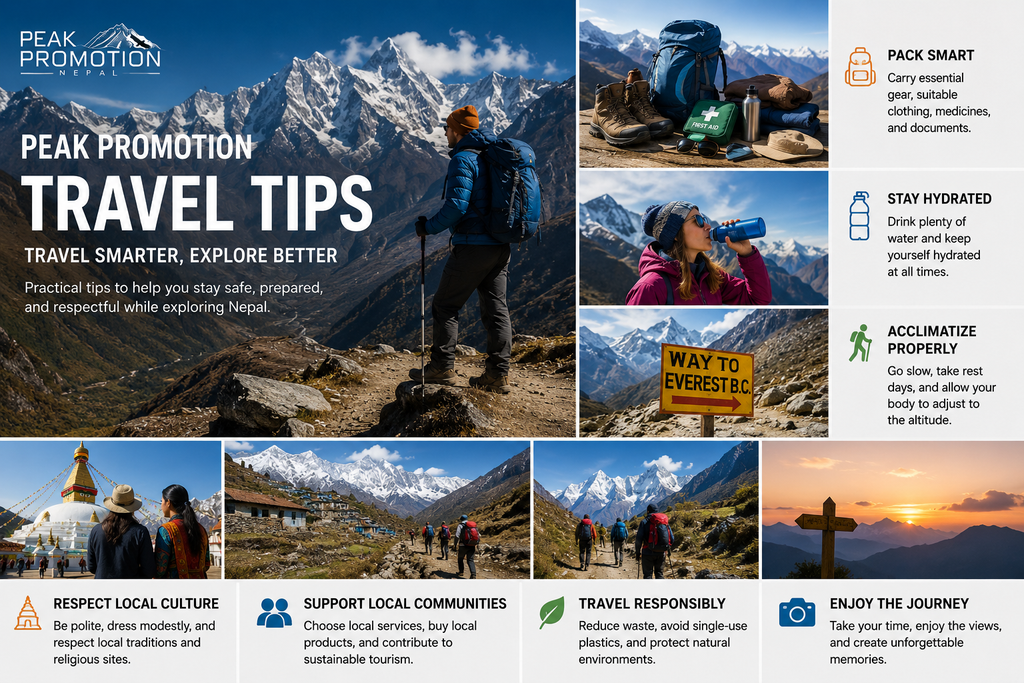
Peak Promotion Travel Tips: Travel Smarter, Explore Better
Traveling in Nepal can take you from historic cities and ancient temples to subtropical jungles, remote mountain villages, and some of the world's highest peaks. Whether you are planning a short cultural holiday, a multi-day trek, a high-altitude expedition, or a combination of experiences, preparation can make a significant difference to your journey.
Good Nepal travel tips are not only about what to pack. They also involve choosing the right season, understanding altitude, preparing for changing weather, respecting local customs, arranging appropriate insurance, staying flexible, and traveling responsibly.
Nepal's geography means that conditions can change dramatically within a relatively short distance. A warm day in the lowlands can be very different from conditions at a high Himalayan trekking destination. Your preparation should therefore match your itinerary, altitude, season, activity, and personal needs.
At Peak Promotion, we believe that exploring Nepal should be about more than reaching a destination. It should be about traveling safely, respecting local communities, protecting the environment, and creating meaningful experiences along the way.
Why Preparation Matters When Traveling in Nepal?
Nepal offers many different types of travel experiences.
You might spend one day exploring Kathmandu's cultural heritage and later travel toward a remote mountain region. A trekking itinerary may involve several hours of walking each day, changing elevations, variable weather, and basic accommodation.
Preparation helps you manage these differences.
Before leaving home, consider:
- Where you are traveling
- What altitude you will reach
- What season you are visiting
- How physically demanding the trip will be
- What equipment you need
- What permits or documents are required
- What insurance coverage you have
- How you will manage health and medications
- What cultural customs you should understand
- How you can minimize your environmental impact
A well-prepared traveler is generally better positioned to deal with unexpected changes without allowing them to disrupt the entire journey.
1. Choose the Right Season for Your Nepal Trip
One of the most important Nepal travel tips is to choose your travel season based on the experience you want.
Nepal has distinct seasonal patterns, but conditions vary between regions and elevations.
Autumn
Autumn, particularly October and November, is widely associated with trekking because many mountain regions often experience clearer conditions after the monsoon.
Potential advantages include:
- Mountain views
- Generally favorable trekking conditions
- Comfortable temperatures in many trekking regions
- Good visibility
- Popular trekking routes
Because autumn is a popular travel period, accommodation and transportation can become busy on major routes.
Spring
March, April, and May are another important period for trekking and mountain travel.
Spring can offer:
- Mild temperatures at lower and middle elevations
- Rhododendron blooms
- Mountain views during favorable conditions
- Trekking opportunities
- Mountaineering activity
Spring is also particularly attractive for travelers interested in seeing Nepal's mountain landscapes combined with flowering forests.
Monsoon
The monsoon season generally brings more rainfall, particularly across many parts of Nepal.
Travel can involve:
- Wet trails
- Muddy roads
- Reduced mountain visibility
- Landslide-related transportation disruptions in some areas
- Leeches on some lower-elevation trails
However, monsoon does not mean that every part of Nepal becomes inaccessible. Rain-shadow regions such as parts of Mustang and Dolpa can provide very different conditions.
Winter
Winter can offer clear mountain views but brings colder temperatures, particularly at higher elevations.
If you are traveling during winter, pay particular attention to:
- Warm clothing
- Sleeping arrangements
- Cold-weather equipment
- Shorter daylight hours
- Snow conditions at higher elevations
The best season depends on your destination and activity, not simply on a general travel calendar.
2. Understand Nepal's Altitude
Altitude is one of the most important factors to consider when planning a Himalayan trek or expedition.
A traveler may be comfortable at a low elevation but experience physical effects as altitude increases.
Altitude-related illness can occur when the body does not have enough time to adapt to reduced oxygen availability.
Common symptoms of acute mountain sickness can include:
- Headache
- Dizziness
- Nausea
- Fatigue
- Difficulty sleeping
- Loss of appetite
More serious altitude-related conditions can also occur and require immediate medical attention.
This is why acclimatization should be an important part of high-altitude trekking preparation.
Practical Altitude Tips:
- Increase altitude gradually.
- Follow the itinerary's acclimatization schedule.
- Stay adequately hydrated.
- Avoid pushing yourself excessively.
- Communicate symptoms to your guide.
- Do not ignore worsening symptoms.
- Follow professional medical advice.
- Be prepared to descend if necessary.
One of the most important principles of high-altitude travel is:
Your itinerary should allow your body time to adapt.
A rushed schedule can create unnecessary risks.
3. Prepare for Changing Mountain Weather
Mountain weather can be unpredictable.
Conditions can change rapidly as elevation increases, and weather may differ significantly between the start and end of a trekking day.
A traveler should therefore avoid relying on a single weather forecast or assuming that conditions will remain constant.
For trekking and expedition travel, pack layers that allow you to adapt.
A practical clothing system can include:
| Layer | Purpose | Examples |
| Base layer | Manage moisture | Thermal or moisture-wicking shirt |
| Mid layer | Insulation | Fleece or lightweight jacket |
| Outer layer | Protection | Waterproof/windproof shell |
| Lower-body layer | Warmth and protection | Trekking pants, thermal layer |
| Accessories | Protect exposed areas | Hat, gloves, buff |
| Footwear | Stability and comfort | Appropriate trekking boots |
The exact equipment should depend on the altitude, season, route, duration, and type of trip.
4. Create a Nepal Travel Packing Checklist
Packing correctly can make a major difference to your comfort.
However, packing everything you own is not the goal.
A better approach is to build your packing list around your itinerary.
✔ Essential Travel Documents
Keep important documents secure and accessible.
Consider carrying:
- Passport
- Visa documentation where applicable
- Travel insurance information
- Trekking or expedition permits where applicable
- Emergency contact information
- Copies of important documents
- Accommodation and transportation details
Digital copies stored securely can provide an additional backup.
✔ Clothing
Your clothing requirements depend heavily on the destination.
For a general Nepal trip, consider:
- Comfortable travel clothing
- Lightweight layers
- Warm jacket
- Waterproof outer layer
- Comfortable walking shoes
- Trekking trousers
- Socks
- Hat
- Gloves
- Sun protection
For high-altitude trekking, your gear list should be significantly more specialized.
✔ Personal and Health Items
Carry personal necessities appropriate to your own circumstances.
These may include:
- Prescription medications
- Basic first-aid supplies
- Sunscreen
- Lip balm
- Personal hygiene products
- Hand sanitizer
- Reusable water bottle
- Water purification method where appropriate
- Sunglasses
- Personal toiletries
If you take prescription medication, keep it in its original packaging and carry sufficient supplies for your itinerary.
5. Choose the Right Trek for Your Experience
Not every trekking route is suitable for every traveler.
When selecting a trek, consider:
- Duration
- Maximum altitude
- Daily walking hours
- Elevation gain
- Trail conditions
- Accommodation
- Weather
- Remoteness
- Physical fitness
- Previous trekking experience
- Availability of guides and support
A shorter trek at moderate altitude may be more appropriate for a first-time trekker than a demanding high-altitude expedition.
Likewise, an experienced trekker should still evaluate a route based on current conditions rather than relying only on previous experience.
Trekking Level and Preparation
| Trip Type | Typical Considerations |
| Short cultural/nature walk | Basic walking fitness |
| Moderate trek | Regular walking and cardiovascular preparation |
| High-altitude trek | Stronger endurance and altitude preparation |
| Technical climbing | Specialized training and equipment |
| Expedition | Extensive physical, technical, logistical and safety preparation |
The most challenging trip is not necessarily the most appropriate trip. Choose an itinerary that matches your abilities, goals, and preparation.
6. Build Your Fitness Before Trekking
You do not need to become an elite athlete to enjoy many trekking routes in Nepal, but preparation helps.
Start training several weeks or months before a demanding trek, depending on your current fitness and itinerary.
Useful Training Activities:
✔ Walking and hiking
Regular walking builds basic endurance and helps your body become accustomed to spending several hours on your feet.
✔ Stair climbing
Stairs can help prepare your legs for sustained elevation gain.
✔ Strength training
Focus on functional movements involving:
- Legs
- Core
- Glutes
- Back
- Balance
✔ Cardiovascular exercise
Activities such as cycling, running, swimming, or brisk walking can help improve cardiovascular endurance.
For more demanding expeditions, training should be tailored to the physical and technical requirements of the objective.
7. Travel Insurance Is an Important Part of Trekking Preparation
Travel insurance should be considered carefully before a Nepal trekking or expedition trip.
Standard travel insurance policies may not automatically cover every trekking or mountaineering activity.
Before purchasing a policy, check whether it covers the activities and elevations included in your itinerary.
Depending on your trip, you may want to review coverage related to:
- Medical treatment
- Emergency evacuation
- Helicopter evacuation
- Trekking
- High-altitude activities
- Trip cancellation
- Lost baggage
- Delays
- Repatriation
Do not assume that a policy covers high-altitude trekking or mountaineering simply because it is described as travel insurance.
Read the exclusions and altitude limits carefully.
8. Stay Hydrated During Your Trek
Hydration is especially important during physical activity.
While trekking, you may spend several hours walking, sometimes in dry or cold environments where you may not notice how much fluid you are losing.
Carry a reusable water bottle or hydration system and plan where you will refill it.
Depending on your route and available facilities, you may also need an appropriate water-treatment method.
Avoid relying entirely on bottled water in remote trekking areas when safe refill and treatment options are available.
This can also help reduce plastic waste.
9. Respect Local Culture and Traditions
Nepal is culturally diverse, with communities following different traditions, languages, religions, and customs.
Travel becomes more meaningful when visitors approach these differences with respect.
Simple Cultural Etiquette:
- Dress appropriately when visiting religious sites.
- Ask before photographing people.
- Follow local rules at temples and monasteries.
- Avoid touching religious objects without permission.
- Respect local ceremonies.
- Remove shoes where required.
- Learn a few basic Nepali greetings.
- Be considerate when entering homes or community spaces.
A simple "Namaste" can be a friendly way to greet people, but genuine respect goes much further than learning a few words.
10. Support Local Communities
Tourism provides income to many people across Nepal.
Your travel decisions can contribute to local economies.
Whenever appropriate, consider supporting:
- Local guides
- Porters
- Family-run lodges
- Local restaurants
- Community homestays
- Local transportation providers
- Handicraft producers
- Small tourism businesses
On trekking routes, guides and porters can play an important role in the overall travel experience.
Fair treatment, appropriate working conditions, and responsible employment practices are important components of sustainable trekking.
11. Travel Responsibly in Nepal's Natural Areas
Nepal's mountains and protected areas are environmentally sensitive.
A responsible traveler should aim to leave as little impact as possible.
Follow the Leave-No-Trace Principle:
▸ Carry out what you carry in.
Do not leave:
- Plastic wrappers
- Bottles
- Batteries
- Tissues
- Food packaging
- Other non-biodegradable waste
Use designated waste-disposal facilities whenever available.
Avoid damaging vegetation, disturbing animals, or taking natural objects from protected areas.
12. Reduce Plastic Waste During Your Trip
Single-use plastic can become a significant environmental issue in remote tourism destinations.
A reusable bottle can reduce your dependence on disposable bottles.
Other practical steps include:
- Carrying reusable bags
- Avoiding unnecessary packaging
- Using refill stations where safe
- Choosing reusable travel products
- Properly disposing of unavoidable waste
- Following local waste-management systems
Responsible tourism is not about being perfect.
It is about making practical choices that reduce unnecessary environmental pressure.
13. Listen to Your Guide
If you are trekking or joining an expedition with a professional guide or expedition team, communication is essential.
Your guide may have experience with:
- Local trail conditions
- Weather
- Altitude
- Accommodation
- Route changes
- Cultural practices
- Emergency procedures
- Local geography
If a guide recommends slowing down, taking a rest day, changing the route, or responding differently to changing conditions, communicate openly and understand the reason behind the decision.
At high altitude, ignoring symptoms or trying to hide physical problems can create unnecessary risks.
14. Keep Your Itinerary Flexible
One of the most useful travel tips for Nepal is to allow some flexibility.
Flights, roads, weather, trail conditions, and mountain conditions can affect travel schedules.
This is particularly important for remote destinations.
If your itinerary has no flexibility at all, even a small delay can create major problems.
Consider allowing buffer time before:
- International flights
- Important events
- Connecting flights
- Major trekking departures
- Expedition schedules
Flexibility can turn an unexpected delay into a manageable inconvenience rather than a major disruption.
15. Prepare for Transportation Differences
Traveling through Nepal can involve several forms of transportation.
Depending on your destination, you might use:
- Private vehicles
- Tourist buses
- Domestic flights
- Local transportation
- Jeeps
- Walking trails
- Porter-supported trekking routes
Travel times can vary considerably because of terrain, road conditions, weather, traffic, and seasonal factors.
When planning a trip, consider travel time rather than relying only on distance.
A route that looks short on a map may take significantly longer than expected.
16. Keep Emergency Contacts Accessible
Before leaving for a trek or remote destination, make sure you know how to contact your travel provider, guide, accommodation, insurance provider, and relevant emergency services.
Keep important information:
- On your phone
- In your travel documents
- With your guide or travel group where appropriate
Also make sure someone you trust knows your general itinerary when traveling independently or heading into a remote area.
17. Travel With Appropriate Technology
Technology can make travel easier, but it should complement—not replace—basic preparation.
Useful items may include:
- Smartphone
- Power bank
- Charging cables
- Offline maps
- Camera
- Headlamp
- Portable battery
- Waterproof phone protection
For remote trekking and expedition environments, communication requirements can be very different from those in cities.
Ask your trekking or expedition operator what communication facilities are available along your route.
18. Respect Wildlife
Nepal's wildlife is an important part of its natural heritage.
Whether visiting Chitwan, Bardia, Sagarmatha, Langtang, or another protected area, observe wildlife responsibly.
Never:
- Feed wild animals
- Chase animals for photographs
- Attempt to touch wildlife
- Make unnecessary noise
- Leave food behind
- Ignore park regulations
A good wildlife encounter should allow animals to behave naturally without unnecessary human interference.
19. Photography: Capture Memories Without Causing Harm
Photography is one of the best ways to preserve travel memories.
However, getting the perfect photograph should never come at the expense of people, wildlife, or cultural heritage.
Before photographing people, ask for permission when appropriate.
When photographing wildlife, maintain a respectful distance and follow your guide's instructions.
At religious and cultural sites, follow photography rules and respect restrictions.
A photograph is a memory—not a reason to disturb the experience of someone else or disrupt wildlife.
20. Plan According to Your Type of Nepal Adventure
Different trips require different preparation.
▸ Cultural Travel
Focus on:
- Comfortable walking shoes
- Cultural etiquette
- Weather-appropriate clothing
- Documents
- Transportation
- Local customs
▸ Wildlife Safari
Focus on:
- Comfortable clothing
- Sun protection
- Binoculars
- Camera equipment
- Insect protection where appropriate
- Park rules
▸ Trekking
Focus on:
- Fitness
- Appropriate footwear
- Layered clothing
- Backpack
- Water
- Navigation
- Acclimatization
- Travel insurance
▸ Mountaineering Expedition
Preparation becomes considerably more specialized.
Depending on the objective, climbers may require:
- Technical climbing equipment
- Specialized clothing
- High-altitude boots
- Harness and protection systems
- Helmet
- Ropes
- Crampons
- Ice axe
- Expedition packs
- High-altitude medical planning
- Technical training
- Experienced expedition support
Equipment requirements should always be determined according to the mountain, route, season, climbing style, and expedition plan.
Nepal Travel Preparation Checklist
Before leaving for your Nepal adventure, use this quick checklist:
| Category | What to Check |
| Documents | Passport, visa, permits, insurance |
| Health | Medication, first aid, medical requirements |
| Clothing | Layers appropriate for destination and season |
| Footwear | Comfortable and activity-appropriate shoes/boots |
| Hydration | Reusable bottle and water-treatment method if required |
| Finance | Payment methods and emergency funds |
| Technology | Phone, charger, power bank |
| Navigation | Offline maps and itinerary |
| Insurance | Trekking/altitude coverage where applicable |
| Fitness | Training appropriate for your itinerary |
| Culture | Local customs and religious etiquette |
| Environment | Reusable items and waste-reduction plan |
| Safety | Emergency contacts and guide information |
| Flexibility | Buffer time for potential delays |
Common Mistakes Travelers Should Avoid in Nepal
Even well-planned trips can become difficult when travelers overlook basic preparation.
Mistake 1: Packing Without Considering Altitude
Clothing suitable for Kathmandu may not be sufficient for a high-altitude trek.
Mistake 2: Choosing a Trek Only by Its Popularity
A popular trek is not automatically suitable for every traveler.
Consider difficulty, altitude, duration, and fitness requirements.
Mistake 3: Ignoring Acclimatization
Trying to reach high elevations too quickly can create serious health risks.
Mistake 4: Underestimating Weather
Mountain conditions can change quickly. Always prepare for variability.
Mistake 5: Ignoring Insurance Exclusions
A policy may exclude certain activities or elevations.
Mistake 6: Overpacking
Carrying unnecessary equipment adds weight and can make trekking more difficult.
Mistake 7: Treating Local Customs as Tourist Attractions
Cultural sites and communities deserve genuine respect rather than simply being treated as photo opportunities.
Mistake 8: Leaving Waste Behind
Remote areas may have limited waste-management infrastructure. Carry your waste responsibly.
Mistake 9: Having an Unrealistically Tight Schedule
Allow additional time when your trip involves remote roads, mountain flights, or weather-sensitive transportation.
Mistake 10: Ignoring Your Guide's Advice
Local knowledge can be extremely valuable, particularly in remote and high-altitude environments.
Peak Promotion Travel Tips for a Better Nepal Experience
At Peak Promotion, travel planning is not simply about creating an itinerary.
A successful Himalayan journey involves coordinating multiple elements—from route planning and transportation to guides, permits, accommodation, equipment, safety, and local logistics.
For travelers considering trekking, mountaineering, or expedition experiences in Nepal, working with an experienced local operator can simplify many of these arrangements.
Depending on the nature of your journey, professional support can help with:
- Trekking itinerary planning
- Expedition logistics
- Local transportation
- Accommodation arrangements
- Guides and support staff
- Permits and documentation
- Equipment coordination
- Route planning
- High-altitude logistics
- Emergency planning
Travelers should always confirm exactly what is included in their selected package and understand the responsibilities of both the operator and traveler.
Frequently Asked Questions (FAQ's):
Q. What is the best time to travel to Nepal?
The best time depends on your destination and activity. Autumn and spring are commonly popular for trekking, while different regions can offer suitable experiences during other seasons.
Q. What should I pack for a trip to Nepal?
Pack according to your destination and activity. General essentials include appropriate clothing, comfortable footwear, documents, medication, travel insurance information, a reusable water bottle, and personal items.
Q. What should I pack for trekking in Nepal?
Trekking equipment can include suitable trekking boots, layered clothing, waterproof protection, a backpack, water bottle, personal medication, sun protection, and other route-specific equipment.
Q. Is acclimatization important when trekking in Nepal?
Yes. Acclimatization is an important part of high-altitude trekking because it gives the body time to adapt to reduced oxygen availability.
Q. Do I need travel insurance for trekking in Nepal?
Travel insurance is strongly worth considering, and trekkers should carefully check whether their policy covers their specific activity, altitude, medical treatment, and emergency evacuation requirements.
Q. How can I avoid altitude sickness in Nepal?
Gradual ascent, appropriate acclimatization, hydration, rest, and paying attention to symptoms are important. Anyone experiencing concerning or worsening symptoms should communicate with their guide and seek appropriate medical assistance.
Q. What is responsible tourism in Nepal?
Responsible tourism means traveling in ways that respect local communities, cultures, wildlife, and the environment while supporting sustainable local economic activity.
Q. How can I reduce plastic waste while traveling in Nepal?
Carry a reusable bottle, use refill and water-treatment options where appropriate, avoid unnecessary single-use products, and dispose of unavoidable waste responsibly.
Q. Should I hire a guide for trekking in Nepal?
The need for a guide depends on the route, regulations, experience, itinerary, and current conditions. A professional guide can provide local knowledge, logistical support, navigation assistance, and help with safety.
Q. How physically fit should I be for trekking in Nepal?
Fitness requirements depend on the trek. Shorter routes may require moderate preparation, while longer and higher-altitude routes require greater endurance and preparation.
Q. Can I travel to Nepal during the monsoon?
Yes. Monsoon travel is possible, but travelers should expect wetter conditions in many areas and should choose destinations and itineraries accordingly. Some rain-shadow regions have different weather patterns.
Q. How should I prepare for a high-altitude expedition?
High-altitude expeditions require considerably more preparation than ordinary tourism. Physical conditioning, acclimatization, technical skills where required, appropriate equipment, permits, logistics, weather planning, insurance, and experienced support should all be considered.
Q. How can I support local communities during my Nepal trip?
Use local guides and services, stay at locally operated accommodations where appropriate, purchase local products, respect community customs, and choose tourism operators that practice responsible employment and environmental standards.
Q. What should I do if my trekking itinerary is affected by weather?
Stay flexible and follow advice from your guide or operator. Mountain weather can affect transportation and trekking schedules, so allowing buffer time in your itinerary is useful.
Conclusion: Travel Well, Travel Responsibly, Discover Nepal
Nepal offers an extraordinary range of experiences—from ancient cultural sites and wildlife-rich lowlands to remote Himalayan trails and high-altitude expeditions.
But a memorable journey begins before you arrive.
Choose the right season, understand your itinerary, prepare your equipment, consider travel insurance, train appropriately, respect altitude, follow local advice, and remain flexible.
Just as importantly, travel responsibly.
Respect Nepal's communities and cultures. Protect its mountains and forests. Reduce waste. Support local businesses. Follow protected-area regulations. Treat wildlife with respect.
Whether you are taking your first Himalayan trek or preparing for a demanding mountaineering expedition, thoughtful preparation allows you to focus on the experience rather than preventable problems.
At Peak Promotion, the goal is to help travelers experience Nepal with appropriate planning, professional support, and respect for the mountains and communities that make the country special.
Travel well. Travel responsibly. Discover Nepal.